
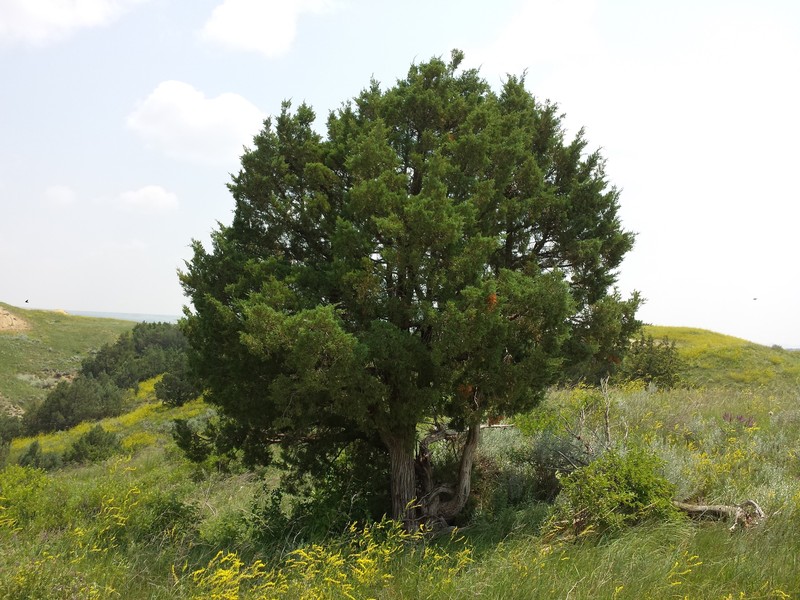
Rocky Mountain Juniper
Juniperus scopulorum
Also known as: Seaside Juniper
Taxonomy
- Division:
- Coniferophyta | - Conifers
- Family:
- Cupressaceae
- Genus:
- Juniperus
- Species:
- Juniperus scopulorum
Growth Characteristics
- Life Cycle:
- Perennial
- Growth Habit:
- Shrub , Tree
- Height:
- More than 40 ft
- Light Requirements:
- Full Sun, Part Shade
- Drought Tolerance:
- High
- Bloom Months:
- apr, may
- Bloom Colors:
- Yellow
- Evergreen Shrub:
- Yes
Native Range
United States: Arizona, Colorado, Idaho, Kansas, Montana, North Dakota, Nebraska, New Mexico, Nevada, Oklahoma, Oregon, South Dakota, Texas, Utah, Washington, Wyoming, Canada: Alberta, British Columbia, Saskatchewan
Keystone Species Ranking
- Caterpillar Keystone:
- ★★☆☆☆ Based on number of butterfly and moth species using this genus as host plant (Source: National Wildlife Federation)
Host Plant for Caterpillars
Soil Requirements
- Soil Type:
- rocky, well-drained, nutrient-poor soil
- pH:
- 6.0 - 8.0 (slightly acidic to neutral)
- Drainage:
- excellent drainage required
- Moisture:
- dry to moderate
- Notes:
- Prefers rocky slopes and foothills in native habitat
Germination Information
Pre-treatment: Seeds are either placed in cold moist stratification for 120 to 150 days or naturally stratified by planting them in the fall in a thin layer of sand on mulched field beds. Alternatively, seeds can be soaked in a running water rinse for 24 hours prior to stratification. Warm moist stratification followed by 6 to 8 months of cold moist chilling is also recommended. Acid scarification for 30 to 60 minutes prior to stratification has improved germination in limited trials.
Establishment: Cuttings can also be used for propagation. Cuttings are treated with 8000 ppm IBA rooting powder, and stuck in mist bed with at least 2 nodes below the surface of the rooting medium. Rooting percentage for cuttings is 68%. Time to transplant is 12 weeks.
Source: npn.rngr.net