
Smooth Sumac
Rhus glabra
Also known as: Hybrid Sumac
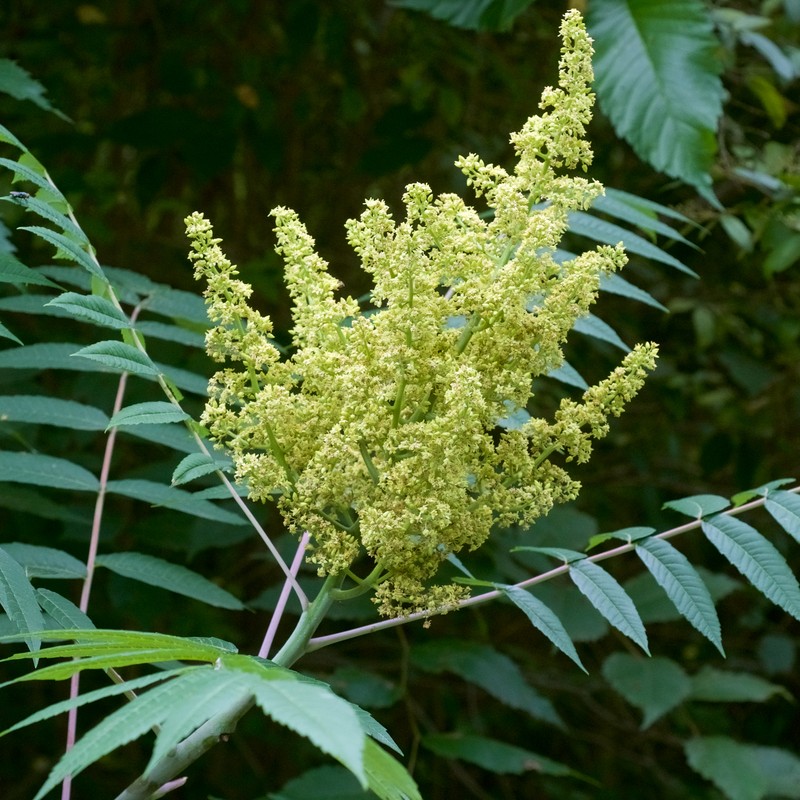
Taxonomy
- Division:
- Magnoliophyta | - Flowering plants
- Family:
- Anacardiaceae
- Genus:
- Rhus
- Species:
- Rhus glabra
Growth Characteristics
- Life Cycle:
- Perennial
- Growth Habit:
- Shrub , Tree
- Height:
- 20-40 ft
- Light Requirements:
- Full Sun, Part Shade, Shade
- Bloom Months:
- may, jun, jul, aug
- Bloom Colors:
- White, Yellow, Green, Brown
- Evergreen Shrub:
- Yes
- Landscaping Shrub:
- Yes
Native Range
United States: Alabama, Arkansas, Arizona, California, Colorado, Connecticut, District of Columbia, Delaware, Florida, Georgia, Iowa, Idaho, Illinois, Indiana, Kansas, Kentucky, Louisiana, Massachusetts, Maryland, Maine, Michigan, Minnesota, Missouri, Mississippi, Montana, North Carolina, North Dakota, Nebraska, New Hampshire, New Jersey, New Mexico, Nevada, New York, Ohio, Oklahoma, Oregon, Pennsylvania, Rhode Island, South Carolina, South Dakota, Tennessee, Texas, Utah, Virginia, Vermont, Washington, Wisconsin, West Virginia, Wyoming, Canada: Alberta, British Columbia, Manitoba, Ontario, Quebec, Saskatchewan
Keystone Species Ranking
- Caterpillar Keystone:
- ★★☆☆☆ Based on number of butterfly and moth species using this genus as host plant (Source: National Wildlife Federation)
Host Plant for Caterpillars
Reported Fauna Sightings
Soil Requirements
- Soil Type:
- well-drained, sandy or rocky soil
- pH:
- 4.5 - 7.5 (acidic to neutral)
- Drainage:
- excellent drainage required
- Moisture:
- dry to moderate
- Notes:
- adaptable to various soil types but prefers dry conditions
Germination Information
Pre-treatment: Seeds are scarified using a sulfuric acid bath, then immediately imbibed in water for 3 days. After pretreatment, seeds are naturally stratified by fall sowing. Some protocols suggest boiling the seed for 1 minute or mechanical scarification.
Establishment: Seeds are typically collected in the fall and stored. Some protocols suggest using a fungicide and endomycorrhizae. There are regional variations in collection and sowing times, and some protocols suggest different scarification methods.
Source: npn.rngr.net