
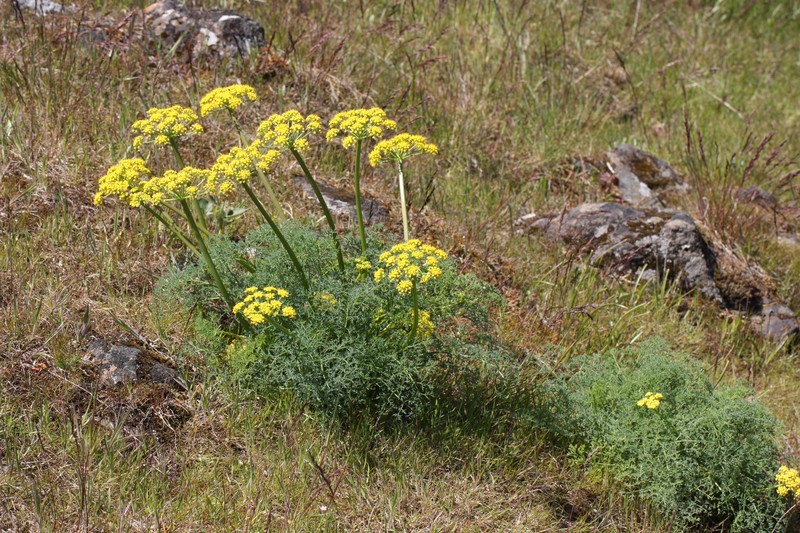
Gray's Biscuitroot
Lomatium grayi
Taxonomy
- Division:
- Magnoliophyta | - Flowering plants
- Family:
- Apiaceae
- Genus:
- Lomatium
- Species:
- Lomatium grayi
Growth Characteristics
- Life Cycle:
- Perennial
- Growth Habit:
- Forb/herb
- Height:
- 3-4 ft
- Light Requirements:
- Full Sun
- Drought Tolerance:
- Medium
- Bloom Months:
- apr, may, jun
- Bloom Colors:
- Yellow
Native Range
United States: Colorado, Idaho, New Mexico, Nevada, Oregon, Utah, Washington, Wyoming, Canada: British Columbia
Host Plant for Caterpillars
Soil Requirements
- Soil Type:
- rocky, well-drained, nutrient-poor soil
- pH:
- 6.0 - 8.0 (slightly acidic to neutral)
- Drainage:
- excellent drainage required
- Moisture:
- dry to moderate
- Notes:
- commonly found in arid, open areas
Germination Information
Pre-treatment: Seeds are soaked in water for 24 hours, placed in clear plastic germination boxes on two layers of blotter paper, thoroughly moistened with distilled water, and placed in germinator at 4°C in the dark for a 60-day prechill. Seed also requires a 3-month moist chilling to relieve dormancy. Fall-dormant seeding is required for field germination.
Establishment: Gray's biscuitroot occurs in Northwest North America, primarily from the Cascade and Sierra Nevada to the Rocky Mountains. The yellow flowers bloom as early as March or April and as late as May. The fruit is mature when it turns brown and dehisces readily, typically 5 to 8 weeks after flowering. Fruits are collected by hand stripping them from the compound umbels into a container. After collection, the seed is thoroughly dried and placed in a standard freezer for 48 hours to remove insect pests. It is stored in a large plastic jar at room temperature for 18 months prior to propagation trials.
Source: npn.rngr.net