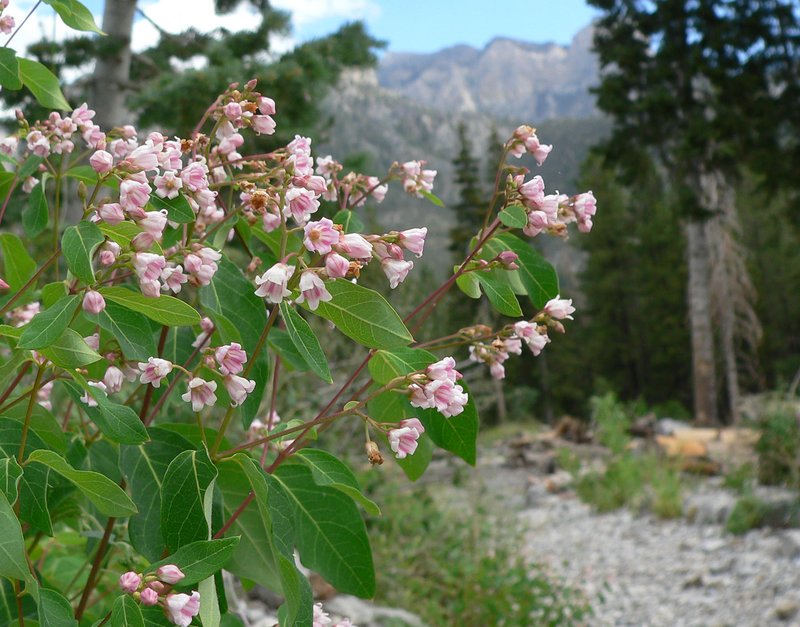
Taxonomy
- Division:
- Magnoliophyta | - Flowering plants
- Family:
- Apocynaceae
- Genus:
- Apocynum
- Species:
- Apocynum androsaemifolium
Growth Characteristics
- Life Cycle:
- Perennial
- Growth Habit:
- Forb/herb
- Height:
- 3-4 ft
- Light Requirements:
- Full Sun, Part Shade, Shade
- Drought Tolerance:
- High
- Bloom Months:
- jun, jul, aug
- Bloom Colors:
- Pink
Native Range
United States: Alaska, Alabama, Arkansas, Arizona, California, Colorado, Connecticut, District of Columbia, Delaware, Georgia, Iowa, Idaho, Illinois, Indiana, Kentucky, Massachusetts, Maryland, Maine, Michigan, Minnesota, Missouri, Montana, North Carolina, North Dakota, Nebraska, New Hampshire, New Jersey, New Mexico, Nevada, New York, Ohio, Oklahoma, Oregon, Pennsylvania, Rhode Island, South Dakota, Tennessee, Texas, Utah, Virginia, Vermont, Washington, Wisconsin, West Virginia, Wyoming, Canada: Alberta, British Columbia, Manitoba, New Brunswick, Nova Scotia, Northwest Territories, Ontario, Prince Edward Island, Quebec, Saskatchewan, Yukon
Keystone Species Ranking
- Caterpillar Keystone:
- ★★★☆☆
Based on number of butterfly and moth species using this genus as host plant (Source: National Wildlife Federation)
Host Plant for Caterpillars
Acronicta noctivaga, blackberry looper (Chlorochlamys chloroleucaria), Catocaline Dart (Cryptocala acadiensis), Clio Tiger Moth (Ectypia clio), Copper Underwing (Amphipyra tragopoginis), Delicate Cycnia (Cycnia tenera), dogbane saucrobotys moth (Saucrobotys futilalis), Large Ruby Tiger Moth (Phragmatobia assimilans), Lined Ruby Tiger Moth (Phragmatobia lineata), Northern Burdock Borer (Papaipema circumlucens), Oregon Cycnia (Cycnia oregonensis), Purple-lined sallow (Pyrrhia exprimens), Six-spotted Gray (Spargaloma sexpunctata), Snowberry Clearwing (Hemaris diffinis), Streaked Salt Marsh Moth (Platarctia parthenos), Striped Garden Caterpillar Moth (Trichordestra legitima), Trichordestra tacoma, ⚠️Monarch butterfly (Danaus plexippus)
Reported Fauna Sightings
Bees: Black-tailed bumble bee (Bombus melanopygus), Black-tailed bumble bee (Bombus melanopygus), Bombus impatiens (Bombus impatiens), Bombus impatiens (Bombus impatiens), Bombus spec (Bombus spec), Bombus ternarius (Bombus ternarius), Bombus ternarius (Bombus ternarius), Brown-belted bumble bee (Bombus griseocollis), Brown-belted bumble bee (Bombus griseocollis), bumblebee (Bombus Latreille), bumblebee (Bombus Latreille), Central bumble bee (Bombus centralis), Central bumble bee (Bombus centralis), Crotch bumble bee (Bombus crotchii), Crotch bumble bee (Bombus crotchii), Fernald cuckoo bumble bee (Bombus flavidus), Fernald cuckoo bumble bee (Bombus flavidus), Fuzzy-horned bumble bee (Bombus mixtus), Fuzzy-horned bumble bee (Bombus mixtus), Half-black bumble bee (Bombus vagans), Half-black bumble bee (Bombus vagans), Hunt's bumble bee (Bombus huntii), Hunt's bumble bee (Bombus huntii), Indiscriminate cuckoo bumble bee (Bombus insularis), Indiscriminate cuckoo bumble bee (Bombus insularis), Nevada bumble bee (Bombus nevadensis), Nevada bumble bee (Bombus nevadensis), Northern amber bumble bee (Bombus borealis), Northern amber bumble bee (Bombus borealis), Orange-tipped Wood-digger Bee (Anthophora terminalis), Orange-tipped Wood-digger Bee (Anthophora terminalis), Red-belted bumble bee (Bombus rufocinctus), Red-belted bumble bee (Bombus rufocinctus), Two-form bumble bee (Bombus bifarius), Two-form bumble bee (Bombus bifarius), Western bumble bee (Bombus occidentalis), Western bumble bee (Bombus occidentalis), White-shouldered bumble bee (Bombus appositus), White-shouldered bumble bee (Bombus appositus), Yellow bumble bee (Bombus fervidus), Yellow bumble bee (Bombus fervidus), Yellow head bumble bee (Bombus flavifrons), Yellow head bumble bee (Bombus flavifrons), Yellow-banded bumble bee (Bombus terricola), Yellow-banded bumble bee (Bombus terricola), Yellow-faced bumble bee (Bombus vosnesenskii), Yellow-faced bumble bee (Bombus vosnesenskii) Butterflies:Acmon Blue (Plebejus acmon), Acmon Blue (Plebejus acmon), American Lady (Vanessa virginiensis), Brown Elfin (Callophrys augustinus), Brown Elfin (Callophrys augustinus), California Tortoiseshell (Nymphalis californica), California Tortoiseshell (Nymphalis californica), Clodius Parnassian (Parnassius clodius), Clodius Parnassian (Parnassius clodius), Echo Azure (Celastrina echo), Echo Azure (Celastrina echo), Lorquin's Admiral (Limenitis lorquini), Lorquin's Admiral (Limenitis lorquini), Northern Checkerspot (Chlosyne palla), Northern Checkerspot (Chlosyne palla), Pale Swallowtail (Pterourus eurymedon), Propertius Duskywing (Erynnis propertius), Propertius Duskywing (Erynnis propertius), Silver-spotted Skipper (Epargyreus clarus), Silver-spotted Skipper (Epargyreus clarus), Southern Cloudywing (Cecropterus Herrich-Schäffer), Western Sulphur (Colias occidentalis), Western Sulphur (Colias occidentalis), Western Tiger Swallowtail (Pterourus rutulus), 🛑Zerene Fritillary (Speyeria zerene), 🛑Zerene Fritillary (Speyeria zerene)
Soil Requirements
- Soil Type:
- sandy, well-drained, nutrient-poor soil
- pH:
- 5.5 - 7.5 (slightly acidic to neutral)
- Drainage:
- excellent drainage required
- Moisture:
- dry to moderate
- Notes:
- Commonly found in open woods and clearings
Germination Information
Pre-treatment: Mix the seeds with an equal amount of moist perlite or vermiculite. Put mixture into a sealed container and proceed with 1 month of moist cold stratification in a cool dry place. Cold store until planted (up to 3 years).
Establishment: Seeds are collected by hand from locally native plants within the eastern central Upper Peninsula. The flowers bloom in June and July. Pods, slender hanging down 7-20cm long. Seed is harvested in September. The plant is commonly found in open pine forests on slopes, prairies, thickets, and along waterways.
Source: npn.rngr.net