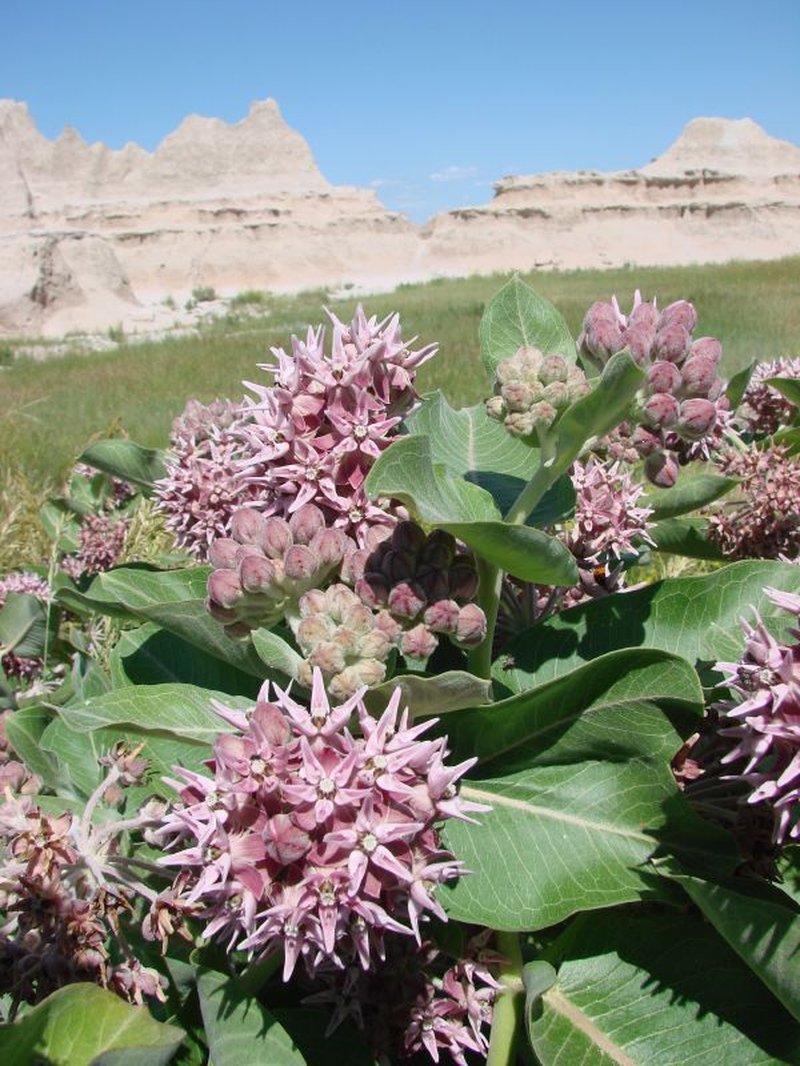
Taxonomy
- Division:
- Magnoliophyta | - Flowering plants
- Family:
- Apocynaceae
- Genus:
- Asclepias
- Species:
- Asclepias speciosa
Growth Characteristics
- Life Cycle:
- Perennial
- Growth Habit:
- Forb/herb
- Height:
- 3-4 ft
- Light Requirements:
- Full Sun
- Drought Tolerance:
- High
- Bloom Months:
- may, jun, jul, aug, sep
- Bloom Colors:
- Pink, Green, Purple
Native Range
United States: Arizona, California, Colorado, Iowa, Idaho, Illinois, Kansas, Michigan, Minnesota, Montana, North Dakota, Nebraska, New Mexico, Nevada, Oklahoma, Oregon, South Dakota, Texas, Utah, Washington, Wisconsin, Wyoming, Canada: Alberta, British Columbia, Manitoba, Saskatchewan
Keystone Species Ranking
- Caterpillar Keystone:
- ★★★★☆
Based on number of butterfly and moth species using this genus as host plant (Source: National Wildlife Federation)
Host Plant for Caterpillars
⚠️Monarch butterfly (Danaus plexippus)
Reported Fauna Sightings
Bees: American bumble bee (Bombus pensylvanicus), American bumble bee (Bombus pensylvanicus), Brown-belted bumble bee (Bombus griseocollis), Brown-belted bumble bee (Bombus griseocollis), Crotch bumble bee (Bombus crotchii), Crotch bumble bee (Bombus crotchii), Fuzzy-horned bumble bee (Bombus mixtus), Fuzzy-horned bumble bee (Bombus mixtus), Hunt's bumble bee (Bombus huntii), Hunt's bumble bee (Bombus huntii), Indiscriminate cuckoo bumble bee (Bombus insularis), Indiscriminate cuckoo bumble bee (Bombus insularis), Morrison bumble bee (Bombus morrisoni), Morrison bumble bee (Bombus morrisoni), Nevada bumble bee (Bombus nevadensis), Nevada bumble bee (Bombus nevadensis), Northern amber bumble bee (Bombus borealis), Northern amber bumble bee (Bombus borealis), Red-belted bumble bee (Bombus rufocinctus), Red-belted bumble bee (Bombus rufocinctus), Southern plains bumble bee (Bombus fraternus), Southern plains bumble bee (Bombus fraternus), Two-form bumble bee (Bombus bifarius), Two-form bumble bee (Bombus bifarius), Two-spotted bumble bee (Bombus bimaculatus), Two-spotted bumble bee (Bombus bimaculatus), Western bumble bee (Bombus occidentalis), Western bumble bee (Bombus occidentalis), White-shouldered bumble bee (Bombus appositus), White-shouldered bumble bee (Bombus appositus), Yellow bumble bee (Bombus fervidus), Yellow bumble bee (Bombus fervidus), Yellow-faced bumble bee (Bombus vosnesenskii), Yellow-faced bumble bee (Bombus vosnesenskii) Butterflies: (Pieris rapae), (Pieris rapae), Clouded Yellows (Colias Fabricius), Lorquin's Admiral (Limenitis lorquini), Lorquin's Admiral (Limenitis lorquini), ⚠️Monarch (Danaus plexippus), Mylitta Crescent (Phyciodes mylitta), Mylitta Crescent (Phyciodes mylitta), Northern Checkerspot (Chlosyne palla), Northern Checkerspot (Chlosyne palla), Orange Sulphur (Colias eurytheme), Orange Sulphur (Colias eurytheme), Painted Lady (Vanessa cardui), Painted Lady (Vanessa cardui), Peck's Skipper (Polites coras), Red Admiral (Vanessa atalanta), Satyr Comma (Polygonia satyrus), Satyr Comma (Polygonia satyrus), Two-tailed Swallowtail (Pterourus multicaudatus), Western Tiger Swallowtail (Pterourus rutulus)
Soil Requirements
- Soil Type:
- well-drained, sandy or loamy soil
- pH:
- 6.0 - 8.0 (slightly acidic to neutral)
- Drainage:
- excellent drainage required
- Moisture:
- dry to moderate
- Notes:
- native to open, sunny areas with poor soil
Germination Information
Pre-treatment: Seeds are stored in cool-dry conditions with temperatures of approximately 10° C (50° F) and relative humidity of 20 to 30%. Some seeds may require a cold stratification treatment for germination, but others may not. Some seeds are soaked in a 1% hydrogen peroxide solution for 24 hours, rinsed, and placed in water for an additional 24 hours, then refrigerated at 1 to 3 °C for 45 days.
Establishment: There are variations in the pre-treatment and establishment protocols among different sources. The germination rate and time range are also variable. The plant is native to mesic places in western North America from British Columbia to Manitoba and south to Texas.
Source: npn.rngr.net