
Small Camas
Camassia quamash
- Native to:
- Canada, United States
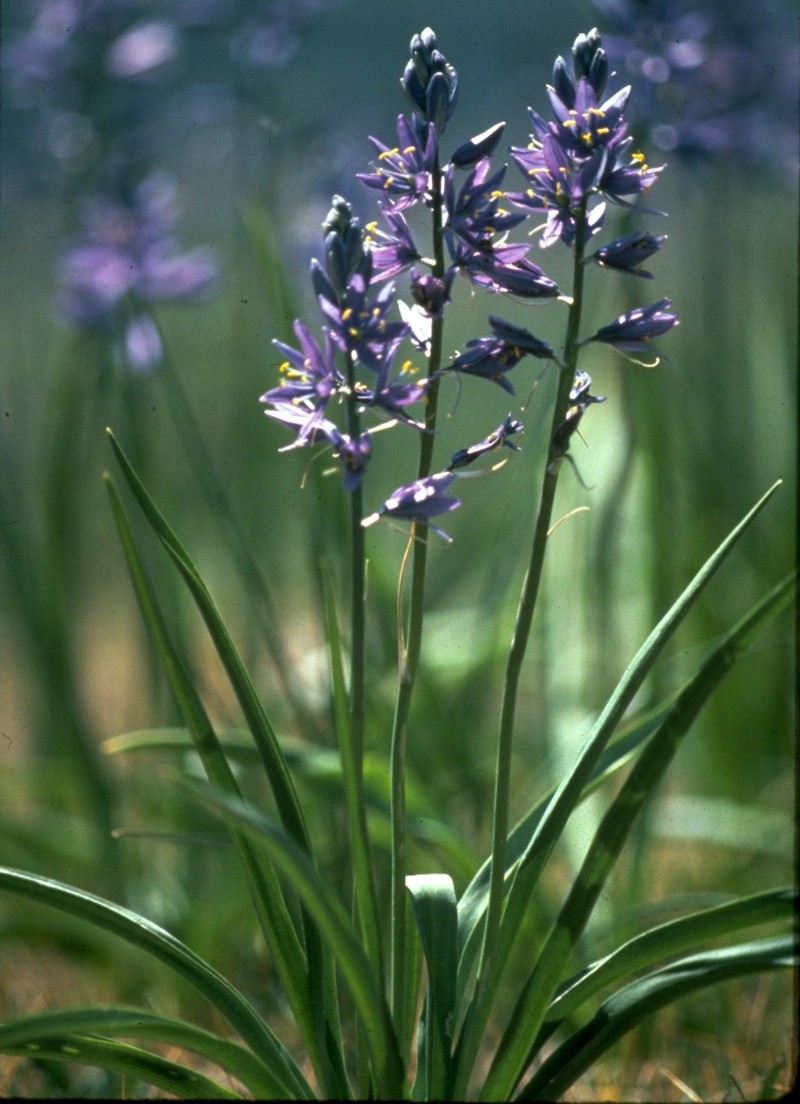
Walter Siegmund (talk)
Taxonomy
- Division:
- Magnoliophyta | - Flowering plants
- Family:
- Asparagaceae
- Genus:
- Camassia
- Species:
- Camassia quamash
- USDA Symbol:
- CAQU2
Growth Characteristics
- Life Cycle:
- Perennial
- Growth Habit:
- Geophyte
- Height:
- 90 cm
- Light Requirements:
- Full Sun
- Drought Tolerance:
- Low
- Bloom Months:
- apr,may,jun
- Bloom Colors:
- blue, purple, white
- Food Forest:
- Contains edible parts
Wildlife Benefits
- Bees:
- ★★☆☆☆ Documented bee visitation (GBIF)
- Butterflies & Moths:
- ★☆☆☆☆ Documented Lepidoptera association (GBIF)
Reported Fauna Sightings
Bees: Fernald cuckoo bumble bee (Bombus flavidus), Nearctic Bumble (Bombus vancouverensis), Red-belted bumble bee (Bombus rufocinctus), Two-form bumble bee (Bombus bifarius), ⚠️Western honey bee (Apis mellifera), Yellow bumble bee (Bombus fervidus), Yellow head bumble bee (Bombus flavifrons), Yellow-faced bumble bee (Bombus vosnesenskii)
Garden & Ecology Notes
- Wildlife Value:
- bees, butterflies, hummingbirds
Soil Requirements
- Soil Type:
- rich, well-drained loamy soil
- pH:
- 5.5 - 7.0 (slightly acidic to neutral)
- Drainage:
- tolerates poor drainage
- Moisture:
- consistently moist
- Notes:
- prefers seasonally wet meadows and prairies
Propagation & Germination
- Stratification:
- Cold/moist stratification required — 60–90 days
- Germination Time:
- 30–60 days
- Notes:
- Seeds require cold stratification for 2-3 months; germination occurs in spring after temperatures warm.
Pre-treatment: Seeds require cold, moist stratification outdoors for 5 months or 42 to 100 days at 1 to 4 °C. Seeds can also be planted outdoors in the fall.
Establishment: Camas can also be propagated from bulbs, particularly for flowering. Bulbs must be 3- to 5-years-old and have 3 to 4 bulb leaves or scales. Bulbs are planted outdoors in the fall or early winter when soils are moist and cool. Four weeks after planting, a 7N:14P2O5:28K2O fertilizer is applied and the bed is kept damp. Watering is discontinued after flowering.
Source: npn.rngr.net
ORGHPS Germination Guide: Sow @ 4C.