
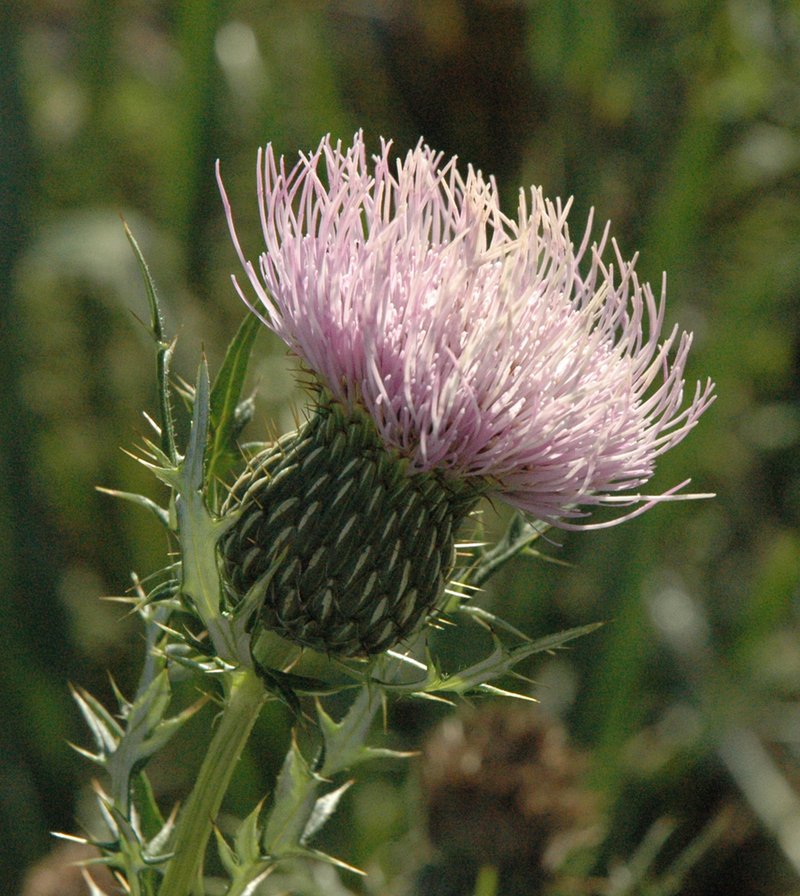
Field Thistle
Cirsium discolor
Taxonomy
- Division:
- Magnoliophyta | - Flowering plants
- Family:
- Asteraceae
- Genus:
- Cirsium
- Species:
- Cirsium discolor
Growth Characteristics
- Life Cycle:
- Biennial | Perennial
- Growth Habit:
- Forb/herb
- Height:
- Less than 6 in
- Light Requirements:
- Full Sun
- Drought Tolerance:
- High
- Bloom Months:
- jun, jul, aug, sep
- Bloom Colors:
- Pink, Purple
Native Range
United States: Alabama, Arkansas, Connecticut, District of Columbia, Delaware, Georgia, Iowa, Illinois, Indiana, Kentucky, Louisiana, Massachusetts, Maryland, Maine, Michigan, Minnesota, Missouri, Mississippi, North Carolina, North Dakota, New Hampshire, New Jersey, New York, Ohio, Pennsylvania, Rhode Island, South Carolina, South Dakota, Tennessee, Texas, Virginia, Vermont, Wisconsin, West Virginia, Canada: Manitoba, Ontario, Quebec, Saskatchewan
Keystone Species Ranking
- Bee Keystone:
- ★★☆☆☆ Based on number of native bee species using this genus for pollen and nectar (Source: National Wildlife Federation)
Host Plant for Caterpillars
Painted Lady (Vanessa cardui)
Reported Fauna Sightings
Bees: American bumble bee (Bombus pensylvanicus), American bumble bee (Bombus pensylvanicus), Black and gold bumble bee (Bombus auricomus), Black and gold bumble bee (Bombus auricomus), Brown-belted bumble bee (Bombus griseocollis), Brown-belted bumble bee (Bombus griseocollis), Common eastern bumble bee (Bombus impatiens), Common eastern bumble bee (Bombus impatiens), Half-black bumble bee (Bombus vagans), Half-black bumble bee (Bombus vagans), Hunt's bumble bee (Bombus huntii), Hunt's bumble bee (Bombus huntii), Lemon cuckoo bumble bee (Bombus citrinus), Lemon cuckoo bumble bee (Bombus citrinus), Northern amber bumble bee (Bombus borealis), Northern amber bumble bee (Bombus borealis), Red-belted bumble bee (Bombus rufocinctus), Red-belted bumble bee (Bombus rufocinctus), 🛑Rusty-patched bumble bee (Bombus affinis), 🛑Rusty-patched bumble bee (Bombus affinis), Southern plains bumble bee (Bombus fraternus), Southern plains bumble bee (Bombus fraternus), Two-spotted bumble bee (Bombus bimaculatus), Two-spotted bumble bee (Bombus bimaculatus), Yellow bumble bee (Bombus fervidus), Yellow bumble bee (Bombus fervidus) Butterflies:Clouded Sulphur (Colias philodice), Clouded Sulphur (Colias philodice), Dun Skipper (Euphyes vestris), Dun Skipper (Euphyes vestris), Eastern Tailed-Blue (Cupido comyntas), Eastern Tailed-Blue (Cupido comyntas), Eastern Tiger Swallowtail (Pterourus glaucus), Eastern Tiger Swallowtail (Pterourus glaucus), Field Skipper (Atalopedes campestris), Field Skipper (Atalopedes campestris), Great Spangled Fritillary (Argynnis cybele), Great Spangled Fritillary (Argynnis cybele), Least Skipper (Ancyloxypha numitor), Least Skipper (Ancyloxypha numitor), Little Glassywing (Vernia verna), Little Glassywing (Vernia verna), ⚠️Monarch (Danaus plexippus), Orange Sulphur (Colias eurytheme), Orange Sulphur (Colias eurytheme), Palamedes Swallowtail (Pterourus palamedes), Pearl Crescent (Phyciodes tharos), Pearl Crescent (Phyciodes tharos), Polites (Polites Scudder), Silver-spotted Skipper (Epargyreus clarus), Silver-spotted Skipper (Epargyreus clarus), Spicebush Swallowtail (Pterourus troilus), Zabulon Skipper (Poanes zabulon), Zabulon Skipper (Poanes zabulon)
Soil Requirements
- Soil Type:
- rich, well-drained loamy soil
- pH:
- 5.5 - 7.0 (slightly acidic to neutral)
- Drainage:
- excellent drainage required
- Moisture:
- dry to moderate
- Notes:
- prefers open fields and prairies
Germination Information
Pre-treatment: Cold-moist stratification for 30 days at 1–5°C (34–41°F).
Source: OpenAI GPT-4o