
Narrowleaf Purple Coneflower
Echinacea angustifolia
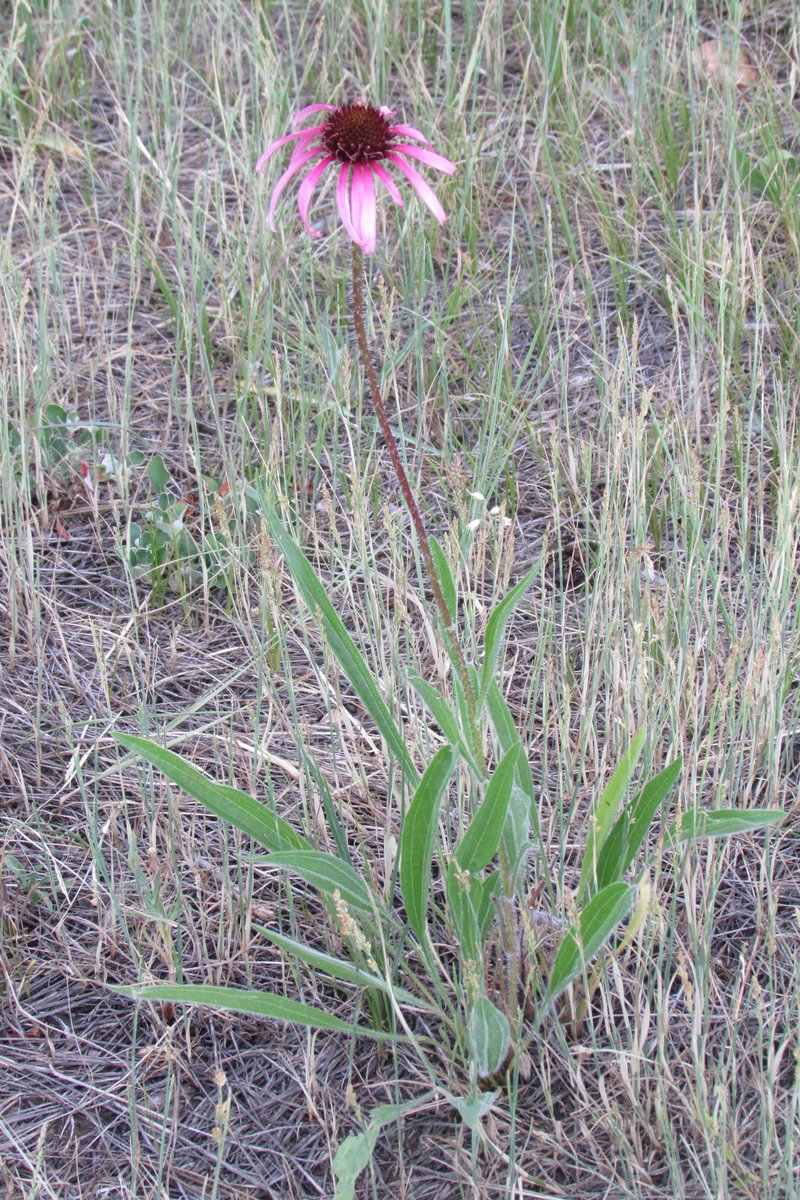
Taxonomy
- Division:
- Magnoliophyta | - Flowering plants
- Family:
- Asteraceae
- Genus:
- Echinacea
- Species:
- Echinacea angustifolia
Growth Characteristics
- Life Cycle:
- Perennial
- Growth Habit:
- Forb/herb
- Height:
- 2-3 ft
- Light Requirements:
- Full Sun, Part Shade
- Drought Tolerance:
- High
- Bloom Months:
- may, jun, jul
- Bloom Colors:
- Pink, Purple
Native Range
United States: Colorado, District of Columbia, Iowa, Kansas, Louisiana, Minnesota, Missouri, Montana, North Dakota, Nebraska, New Mexico, New York, Oklahoma, South Dakota, Texas, Wyoming, Canada: Manitoba, Saskatchewan
Keystone Species Ranking
- Bee Keystone:
- ★★★★★ Based on number of native bee species using this genus for pollen and nectar (Source: National Wildlife Federation)
Reported Fauna Sightings
Bees: American bumble bee (Bombus pensylvanicus), American bumble bee (Bombus pensylvanicus), Black and gold bumble bee (Bombus auricomus), Black and gold bumble bee (Bombus auricomus), Brown-belted bumble bee (Bombus griseocollis), Brown-belted bumble bee (Bombus griseocollis), Common eastern bumble bee (Bombus impatiens), Common eastern bumble bee (Bombus impatiens), Half-black bumble bee (Bombus vagans), Half-black bumble bee (Bombus vagans), Nevada bumble bee (Bombus nevadensis), Nevada bumble bee (Bombus nevadensis), Southern plains bumble bee (Bombus fraternus), Southern plains bumble bee (Bombus fraternus), Tri-colored bumble bee (Bombus ternarius), Tri-colored bumble bee (Bombus ternarius)
Soil Requirements
- Soil Type:
- sandy, well-drained, nutrient-poor soil
- pH:
- 6.0 - 7.5 (slightly acidic to neutral)
- Drainage:
- excellent drainage required
- Moisture:
- dry to moderate
- Notes:
- Prefers open prairies and dry plains
Germination Information
Pre-treatment: 9 to 15 weeks cold-moist stratification
Establishment: The plant is commonly found in open rocky prairies and plains on the Great Plains, less frequent on the far-western edge; rarely existing east to central New Mexico and northwest Iowa. It is also found in the eastern half of the United states; ranging west to eastern Minnesota and Iowa.
Source: npn.rngr.net