
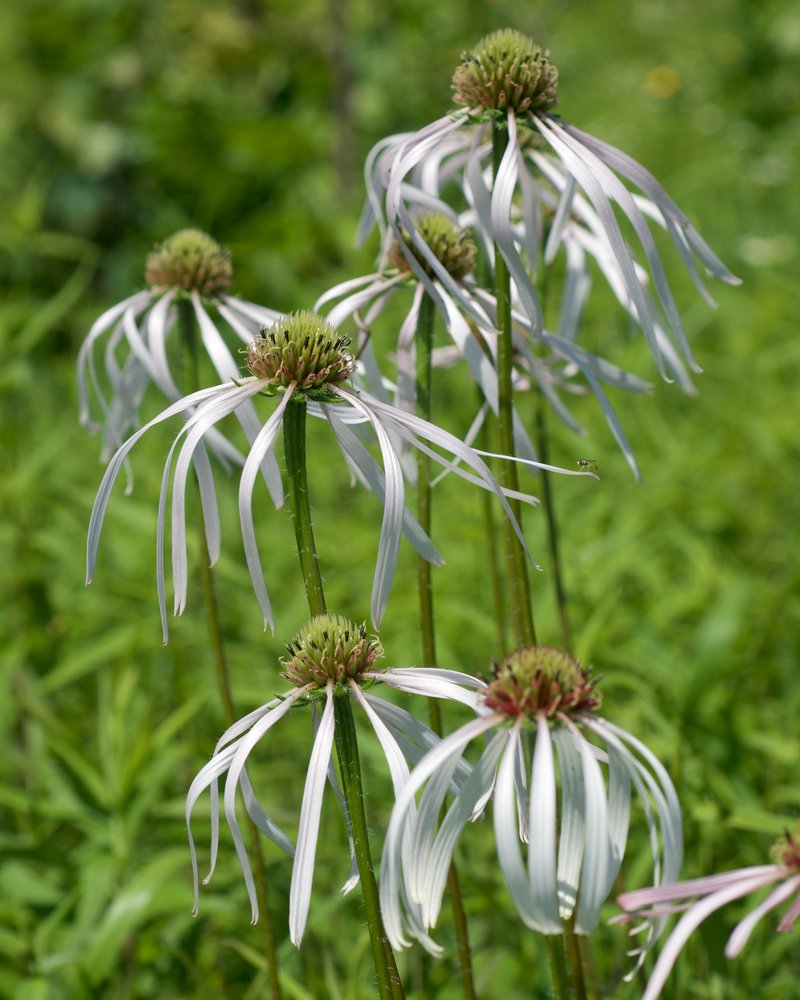
Pale Purple Coneflower
Echinacea pallida
Taxonomy
- Division:
- Magnoliophyta | - Flowering plants
- Family:
- Asteraceae
- Genus:
- Echinacea
- Species:
- Echinacea pallida
Growth Characteristics
- Life Cycle:
- Perennial
- Growth Habit:
- Forb/herb
- Height:
- 4-6 ft
- Light Requirements:
- Full Sun
- Drought Tolerance:
- High
- Bloom Months:
- may, jun, jul
- Bloom Colors:
- Pink, Purple
Native Range
United States: Alabama, Arkansas, Connecticut, Georgia, Iowa, Illinois, Indiana, Kansas, Louisiana, Massachusetts, Maryland, Maine, Michigan, Missouri, North Carolina, Nebraska, New York, Oklahoma, South Carolina, Tennessee, Texas, Virginia, Wisconsin, Canada: Ontario
Keystone Species Ranking
- Bee Keystone:
- ★★★★★ Based on number of native bee species using this genus for pollen and nectar (Source: National Wildlife Federation)
Reported Fauna Sightings
Soil Requirements
- Soil Type:
- well-drained, sandy or rocky soil
- pH:
- 5.5 - 7.0 (slightly acidic to neutral)
- Drainage:
- excellent drainage required
- Moisture:
- dry to moderate
- Notes:
- native to prairies and open woodlands
Germination Information
Pre-treatment: Seeds should be dry stored for 1 to 2 years and then placed into a 60 to 90 day cold, moist stratification at 1 to 3 C. If unable to plant in the fall, store the seed dry in cold storage at 34-36 degrees F. If seeds exhibit physiological dormancy, cold, moist stratification for 28 days at 1 to 2øC (34 to 36øF) may improve germination.
Establishment: Seeds are collected when they are easily removed from the head in August and September. They are dark grey at maturity. Field seed is not damp stratified due to clumping problems during the drilling process. If the seed has not germinated by the first week of May, there has been a problem, ie, seed not planted at the correct depth, blown away, or bad seed lot.
Source: npn.rngr.net