
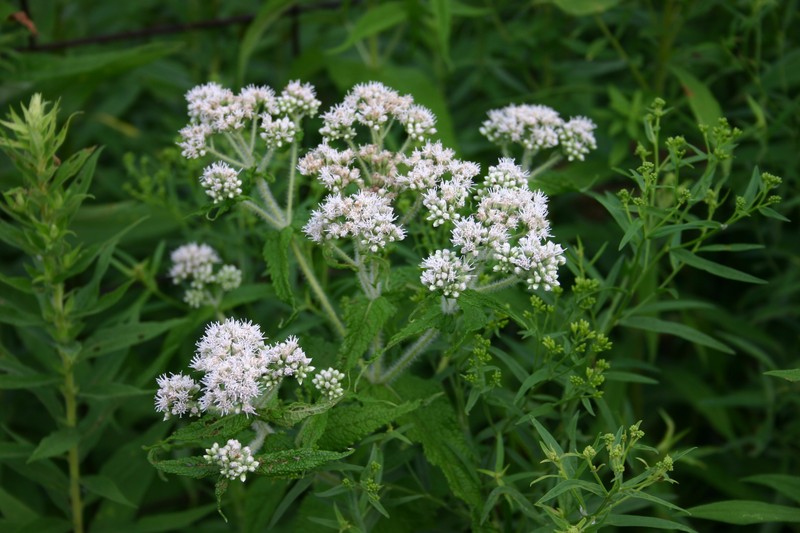
Common Boneset
Eupatorium perfoliatum
Also known as: Chapman's Thoroughwort
Taxonomy
- Division:
- Magnoliophyta | - Flowering plants
- Family:
- Asteraceae
- Genus:
- Eupatorium
- Species:
- Eupatorium perfoliatum
Growth Characteristics
- Life Cycle:
- Perennial
- Growth Habit:
- Forb/herb
- Height:
- 6-8 ft
- Light Requirements:
- Full Sun, Part Shade, Shade
- Drought Tolerance:
- High
- Bloom Months:
- jun, jul, aug, sep, oct
- Bloom Colors:
- White
Native Range
United States: Alabama, Arkansas, Connecticut, District of Columbia, Delaware, Florida, Georgia, Iowa, Illinois, Indiana, Kansas, Kentucky, Louisiana, Massachusetts, Maryland, Maine, Michigan, Minnesota, Missouri, Mississippi, North Carolina, North Dakota, Nebraska, New Hampshire, New Jersey, New York, Ohio, Oklahoma, Pennsylvania, Rhode Island, South Carolina, South Dakota, Tennessee, Texas, Virginia, Vermont, Wisconsin, West Virginia, Canada: Manitoba, New Brunswick, Nova Scotia, Ontario, Prince Edward Island, Quebec
Keystone Species Ranking
- Caterpillar Keystone:
- ★★★☆☆ Based on number of butterfly and moth species using this genus as host plant (Source: National Wildlife Federation)
Host Plant for Caterpillars
Reported Fauna Sightings
Soil Requirements
- Soil Type:
- rich, moist, well-drained loamy soil
- pH:
- 5.5 - 7.0 (slightly acidic to neutral)
- Drainage:
- tolerates poor drainage
- Moisture:
- consistently moist
- Notes:
- Commonly found in wetlands and along stream banks
Germination Information
Pre-treatment: Mix the seeds with an equal amount of either perlite or vermiculite. Seal mixture into a Ziploc-style bag or a Rubbermaid-style container, 1 month of moist cold stratification in a cool dry place (refrigerator or cold garage). Cold store until planted (up to 3 years).
Establishment: Seed is collected by hand from locally native plants in the eastern central Upper Peninsula and at Washington Memorial Parkway, TRI Swamp trail. The plant blooms in the summer and fall. Seed is an achene with pappus and is harvested in the fall. The plant grows in full sun and is found in marshes, swales, wet fields, fens, conifer swamps, thickets, low clearings, river and stream banks. It can reach a height of up to 5' with white flowers.
Source: npn.rngr.net