
Jerusalem Artichoke
Helianthus tuberosus
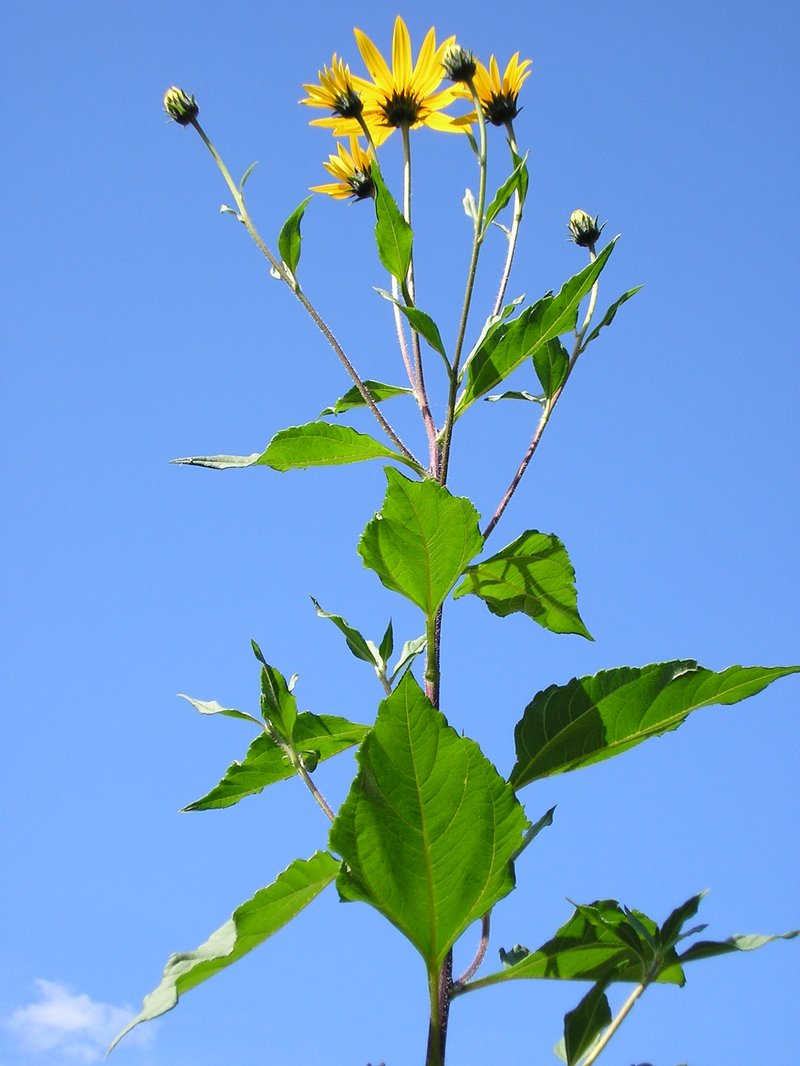
Taxonomy
- Division:
- Magnoliophyta | - Flowering plants
- Family:
- Asteraceae
- Genus:
- Helianthus
- Species:
- Helianthus tuberosus
Growth Characteristics
- Life Cycle:
- Perennial
- Growth Habit:
- Forb/herb
- Height:
- 8-12 ft
- Light Requirements:
- Full Sun
- Drought Tolerance:
- Medium
- Bloom Months:
- aug, sep, oct
- Bloom Colors:
- Red, Pink, Yellow
- Food Forest:
- Plant contains edible parts
Native Range
United States: Alabama, Arkansas, California, Colorado, Connecticut, District of Columbia, Delaware, Florida, Georgia, Iowa, Idaho, Illinois, Indiana, Kansas, Kentucky, Louisiana, Massachusetts, Maryland, Maine, Michigan, Minnesota, Missouri, Mississippi, Montana, North Carolina, North Dakota, Nebraska, New Hampshire, New Jersey, New York, Ohio, Oklahoma, Oregon, Pennsylvania, Rhode Island, South Carolina, South Dakota, Tennessee, Texas, Utah, Virginia, Vermont, Washington, Wisconsin, West Virginia, Wyoming, Canada: Manitoba, New Brunswick, Nova Scotia, Ontario, Prince Edward Island, Quebec, Saskatchewan
Keystone Species Ranking
- Caterpillar Keystone:
- ★★☆☆☆ Based on number of butterfly and moth species using this genus as host plant (Source: National Wildlife Federation)
- Bee Keystone:
- ★☆☆☆☆ Based on number of native bee species using this genus for pollen and nectar (Source: National Wildlife Federation)
Host Plant for Caterpillars
American sunflower moth (Homoeosoma electella), Army cutworm (Euxoa auxiliaris), Common Pinkband (Ogdoconta cinereola), Dichomeris juncidella, Eucosma bilineana, Eucosma sombreana, ⚠️maritime borer moth (Papaipema maritima), ⚠️Papaipema necopina (Papaipema necopina), Rigid Borer Moth (Papaipema rigida), Bordered Patch (Chlosyne lacinia), orange oakleaf (Charidryas nycteis)
Reported Fauna Sightings
Bees: American bumble bee (Bombus pensylvanicus), American bumble bee (Bombus pensylvanicus), Brown-belted bumble bee (Bombus griseocollis), Brown-belted bumble bee (Bombus griseocollis), Common eastern bumble bee (Bombus impatiens), Common eastern bumble bee (Bombus impatiens), Half-black bumble bee (Bombus vagans), Half-black bumble bee (Bombus vagans), Red-belted bumble bee (Bombus rufocinctus), Red-belted bumble bee (Bombus rufocinctus), Southern plains bumble bee (Bombus fraternus), Southern plains bumble bee (Bombus fraternus), Tri-colored bumble bee (Bombus ternarius), Tri-colored bumble bee (Bombus ternarius) Butterflies:Black Swallowtail (Papilio polyxenes), (Pieris rapae), (Pieris rapae), Common Buckeye (Junonia coenia), Common Buckeye (Junonia coenia), Eastern Tailed-Blue (Cupido comyntas), Eastern Tailed-Blue (Cupido comyntas), Field Skipper (Atalopedes campestris), Field Skipper (Atalopedes campestris), Fiery Skipper (Hylephila phyleus), Fiery Skipper (Hylephila phyleus), ⚠️Monarch (Danaus plexippus), Pearl Crescent (Phyciodes tharos), Pearl Crescent (Phyciodes tharos), Peck's Skipper (Polites coras), Question Mark (Polygonia interrogationis), Red-Spotted Purple (astyanax) (Limenitis arthemis), Red-Spotted Purple (astyanax) (Limenitis arthemis), Silver-spotted Skipper (Epargyreus clarus), Silver-spotted Skipper (Epargyreus clarus)
Soil Requirements
- Soil Type:
- rich, well-drained loamy soil
- pH:
- 5.5 - 7.5 (slightly acidic to neutral)
- Drainage:
- tolerates poor drainage
- Moisture:
- consistently moist
- Notes:
- prefers fertile soils with organic matter