
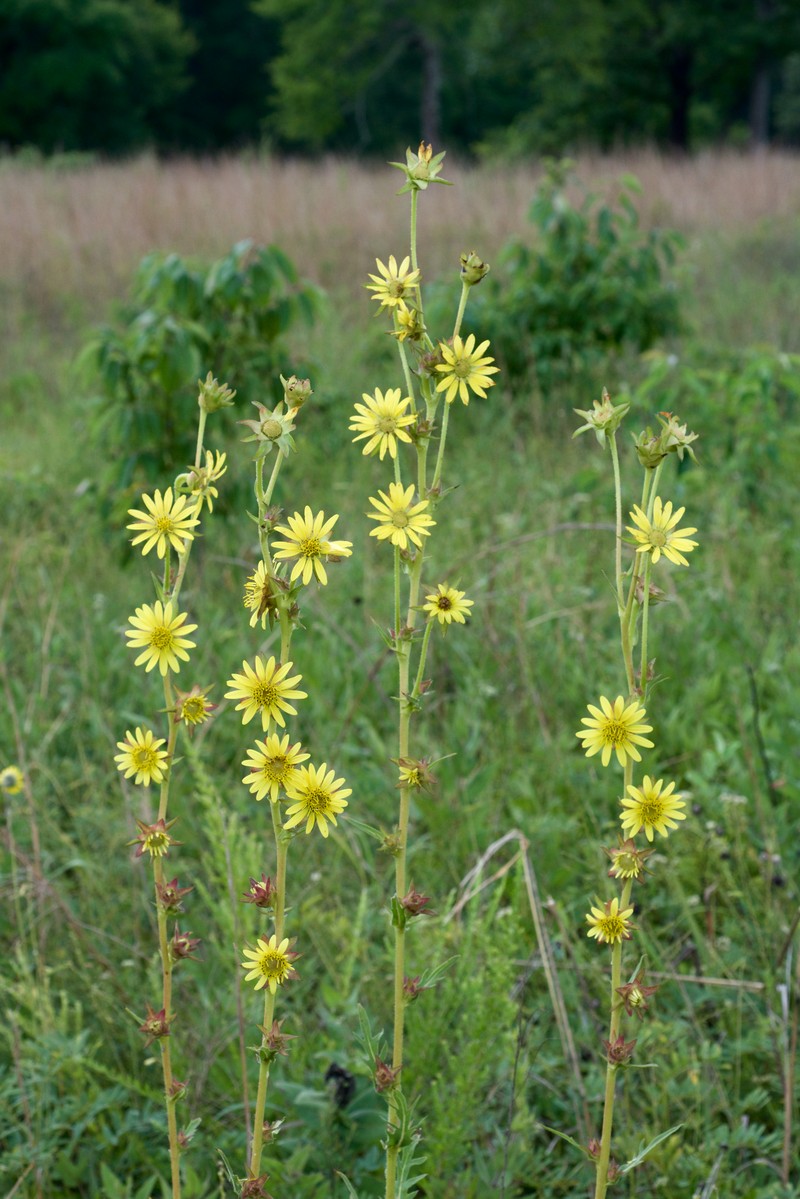
Compassplant
Silphium laciniatum
Taxonomy
- Division:
- Magnoliophyta | - Flowering plants
- Family:
- Asteraceae
- Genus:
- Silphium
- Species:
- Silphium laciniatum
Growth Characteristics
- Life Cycle:
- Perennial
- Growth Habit:
- Forb/herb
- Height:
- 8-12 ft
- Light Requirements:
- Full Sun
- Drought Tolerance:
- High
- Bloom Months:
- jul, aug, sep
- Bloom Colors:
- Yellow
Native Range
United States: Alabama, Arkansas, Colorado, District of Columbia, Iowa, Illinois, Indiana, Kansas, Kentucky, Louisiana, Michigan, Minnesota, Missouri, Mississippi, North Dakota, Nebraska, New Mexico, New York, Ohio, Oklahoma, Pennsylvania, South Dakota, Tennessee, Texas, Virginia, Wisconsin, Canada: Ontario
Keystone Species Ranking
- Bee Keystone:
- ★★★★☆ Based on number of native bee species using this genus for pollen and nectar (Source: National Wildlife Federation)
Host Plant for Caterpillars
Eucosma bipunctella, silphius borer moth (Papaipema silphii)
Reported Fauna Sightings
Bees: American bumble bee (Bombus pensylvanicus), American bumble bee (Bombus pensylvanicus), Black and gold bumble bee (Bombus auricomus), Black and gold bumble bee (Bombus auricomus), Brown-belted bumble bee (Bombus griseocollis), Brown-belted bumble bee (Bombus griseocollis), Common eastern bumble bee (Bombus impatiens), Common eastern bumble bee (Bombus impatiens), Hunt's bumble bee (Bombus huntii), Hunt's bumble bee (Bombus huntii), Yellow-faced bumble bee (Bombus vosnesenskii), Yellow-faced bumble bee (Bombus vosnesenskii)
Soil Requirements
- Soil Type:
- rich, well-drained loamy soil
- pH:
- 6.0 - 7.5 (slightly acidic to neutral)
- Drainage:
- excellent drainage required
- Moisture:
- dry to moderate
- Notes:
- native to prairies and open woodlands
Germination Information
Pre-treatment: Seeds are placed in cold moist stratification for 150 days or field seed is planted in the fall without cold storage.
Establishment: Seed is collected by hand from nursery stock. The plant flowers from approx. June 27 to August 20. Seed is harvested about August 25. The species is found from Ohio to Alabama west to the Great Plains states.
Source: npn.rngr.net