
New York Ironweed
Vernonia noveboracensis
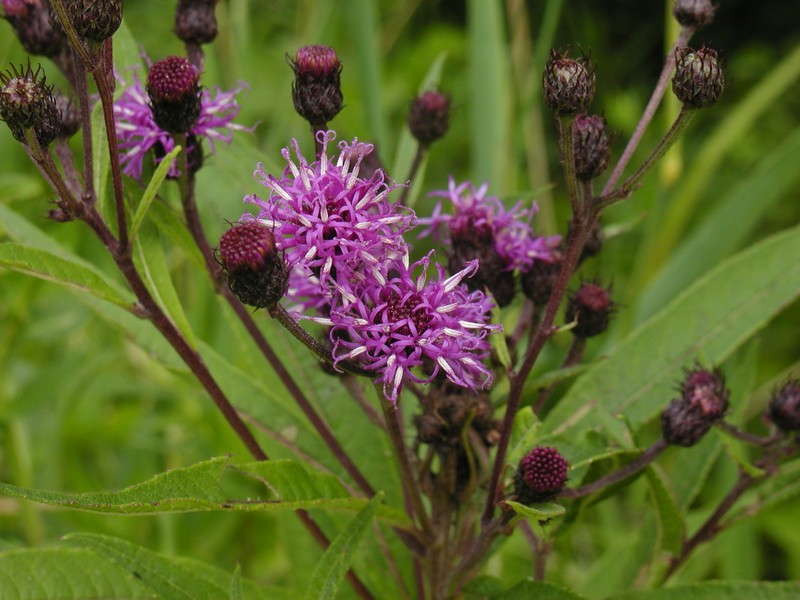
Taxonomy
- Division:
- Magnoliophyta | - Flowering plants
- Family:
- Asteraceae
- Genus:
- Vernonia
- Species:
- Vernonia noveboracensis
Growth Characteristics
- Life Cycle:
- Perennial
- Growth Habit:
- Forb/herb
- Height:
- 6-8 ft
- Light Requirements:
- Full Sun
- Drought Tolerance:
- Medium
- Bloom Months:
- aug, sep
- Bloom Colors:
- Red, Purple
Native Range
United States: Alabama, Connecticut, District of Columbia, Delaware, Florida, Georgia, Kentucky, Massachusetts, Maryland, North Carolina, New Hampshire, New Jersey, New Mexico, New York, Ohio, Pennsylvania, Rhode Island, South Carolina, Tennessee, Virginia, West Virginia
Keystone Species Ranking
- Bee Keystone:
- ★★★★☆ Based on number of native bee species using this genus for pollen and nectar (Source: National Wildlife Federation)
Host Plant for Caterpillars
Endopiza vernoniana, green cloverworm moth (Platynota idaeusalis), ironweed borer moth (Papaipema cerussata), ironweed clearwing (Carmenta bassiformis), mugwort plume moth (Hellinsia paleaceus), Parthenice tiger moth (Grammia parthenice), red groundling moth (Perigea xanthioides), Ruby Tiger Moth (Phragmatobia fuliginosa), Salt Marsh Moth (Estigmene acrea), Spotted Tussock Moth (Lophocampa maculata), Yellow-striped armyworm (Spodoptera ornithogalli), ⚠️Diana fritillary (Speyeria diana)
Reported Fauna Sightings
Bees: American bumble bee (Bombus pensylvanicus), American bumble bee (Bombus pensylvanicus), Common eastern bumble bee (Bombus impatiens), Common eastern bumble bee (Bombus impatiens), Tri-colored bumble bee (Bombus ternarius), Tri-colored bumble bee (Bombus ternarius), Yellow bumble bee (Bombus fervidus), Yellow bumble bee (Bombus fervidus)
Soil Requirements
- Soil Type:
- rich, well-drained loamy soil
- pH:
- 5.5 - 7.0 (slightly acidic to neutral)
- Drainage:
- tolerates poor drainage
- Moisture:
- consistently moist
- Notes:
- prefers wet meadows and stream banks
Germination Information
Pre-treatment: Seeds are given a 4-week cool stratification period.
Establishment: Collected at George Washington Memorial Parkway, Dead Run and TRI by J. Englert in 11/95; Great Smoky Mountains National Park, by J. Beeler on 10/21/99 and 10/26/00. Found in low wet woods and marshes, especially near coast.
Source: npn.rngr.net