
Twinflower
Linnaea borealis
- Native to:
- Aleutian Is., Austria, Baltic States, Belarus, Canada, China, Czechia-Slovakia, Denmark, Finland, France, Germany, Great Britain, Greenland, Italy, Japan, Kazakhstan, Korea, Kuril Is., Labrador, Netherlands, North Caucasus, Norway, NW. Balkan Pen., Poland, Prince Edward I., Romania, Russia, Sweden, Switzerland, Transcaucasus, Uganda, Ukraine, United States
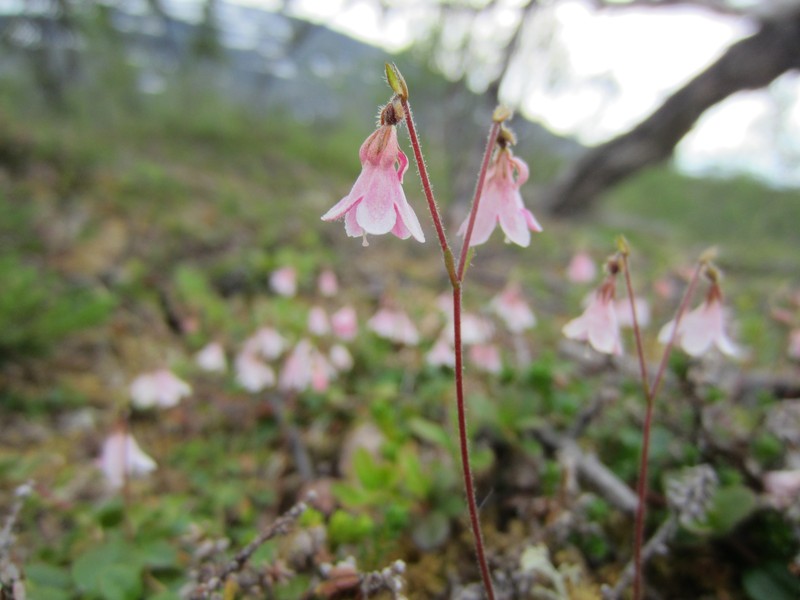
Statskog SF (www.flickr.com)
Taxonomy
- Division:
- Magnoliophyta | - Flowering plants
- Family:
- Caprifoliaceae
- Genus:
- Linnaea
- Species:
- Linnaea borealis
- USDA Symbol:
- LIBO3
Growth Characteristics
- Life Cycle:
- Perennial
- Growth Habit:
- Forb/herb , Subshrub
- Height:
- 15 cm
- Light Requirements:
- Full Sun,Part Shade,Shade
- Drought Tolerance:
- Low
- Bloom Months:
- jun,jul,aug
- Bloom Colors:
- pink, white
- Ground Cover:
- Yes
Wildlife Benefits
- Bees:
- ★☆☆☆☆ Documented bee visitation (GBIF)
- Butterflies & Moths:
- ★☆☆☆☆ Documented Lepidoptera association (GBIF)
Garden & Ecology Notes
- Wildlife Value:
- bees, butterflies
- Fragrant:
- Yes
Soil Requirements
- Soil Type:
- moist, acidic, well-drained soil
- pH:
- 4.5 - 6.5 (acidic to slightly acidic)
- Drainage:
- excellent drainage required
- Moisture:
- consistently moist
- Notes:
- prefers cool, shaded forest floors
Propagation & Germination
- Stratification:
- Cold/moist stratification required — 60–90 days
- Germination Time:
- 30–60 days
- Notes:
- Seeds benefit from cold stratification; germination occurs in spring under cool, moist conditions.
Pre-treatment: Seeds: Cold moist stratification for 60 days. Cuttings: Pinned in 50% perlite and 50% sand rooting medium under mist with bottom heat for 7 weeks.
Establishment: Seeds are collected in late August when they turn brown. Each capsule contains only one seed, thus large quantities are needed. Cuttings are taken in late June from healthy field plants in partial sun exposure. Cuttings are 30 cm in length. Germination for seeds occurred in late May following several days of temperatures of 22C or above during the day.
Source: npn.rngr.net
ORGHPS Germination Guide: Sow immediately, Either the viability of these seeds is short or the species propagates best with fresh seed. Stored seed might be coaxed into germination with temperature cycling and patience. Expose to fluctuation outdoor winter temperatures including freezing for 3 months. Gradually increase light and temperature in the spring. * mainly reproduce by stolons; < 3% of seeds viable, very difficult