
Tatarian Honeysuckle
Lonicera tatarica
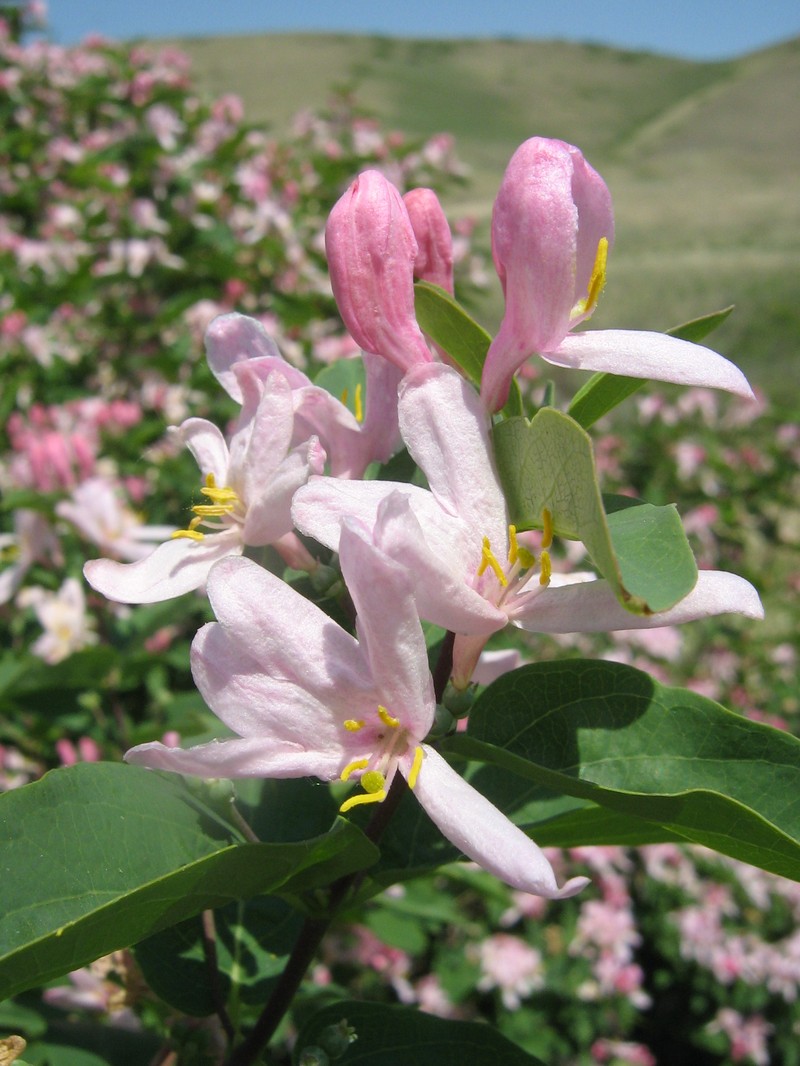
dave_7 from Lethbridge, Canada
Taxonomy
- Division:
- Magnoliophyta | - Flowering plants
- Family:
- Caprifoliaceae
- Genus:
- Lonicera
- Species:
- Lonicera tatarica
Growth Characteristics
- Life Cycle:
- Perennial
- Growth Habit:
- Shrub
- Height:
- 8-12 ft
- Light Requirements:
- Full Sun
- Drought Tolerance:
- High
- Bloom Months:
- mar, apr, may, jun, jul, aug
- Bloom Colors:
- pink, red, white
- Landscaping Shrub:
- Yes
Native Range
United States: Alaska, California, Colorado, Connecticut, Delaware, Iowa, Idaho, Illinois, Indiana, Kansas, Kentucky, Massachusetts, Maryland, Maine, Michigan, Minnesota, Montana, North Dakota, Nebraska, New Hampshire, New Jersey, New Mexico, New York, Ohio, Oregon, Pennsylvania, Rhode Island, South Dakota, Texas, Utah, Virginia, Vermont, Washington, Wisconsin, West Virginia, Wyoming, Canada: Alberta, Manitoba, New Brunswick, Nova Scotia, Ontario, Quebec, Saskatchewan
Keystone Species Ranking
- Caterpillar Keystone:
- ★★★☆☆ Based on number of butterfly and moth species using this genus as host plant (Source: National Wildlife Federation)
Host Plant for Caterpillars
Cecropia moth (Hyalophora cecropia), Giant leopard moth (Hypercompe scribonia), Hitched Arch (Melanchra adjuncta), Phyllonorycter emberizaepenella, Polia purpurissata, Snowberry Clearwing (Hemaris diffinis), Holly Blue (Celastrina argiolus)
Reported Fauna Sightings
Bees: American bumble bee (Bombus pensylvanicus), American bumble bee (Bombus pensylvanicus), Brown-belted bumble bee (Bombus griseocollis), Brown-belted bumble bee (Bombus griseocollis), Common eastern bumble bee (Bombus impatiens), Common eastern bumble bee (Bombus impatiens), Hunt's bumble bee (Bombus huntii), Hunt's bumble bee (Bombus huntii), Nevada bumble bee (Bombus nevadensis), Nevada bumble bee (Bombus nevadensis), Two-spotted bumble bee (Bombus bimaculatus), Two-spotted bumble bee (Bombus bimaculatus)
Soil Requirements
- Soil Type:
- rich, well-drained loamy soil
- pH:
- 6.0 - 7.5 (slightly acidic to neutral)
- Drainage:
- tolerates poor drainage
- Moisture:
- dry to moderate
- Notes:
- native to open woodlands and forest edges