
Bunchberry Dogwood
Cornus canadensis
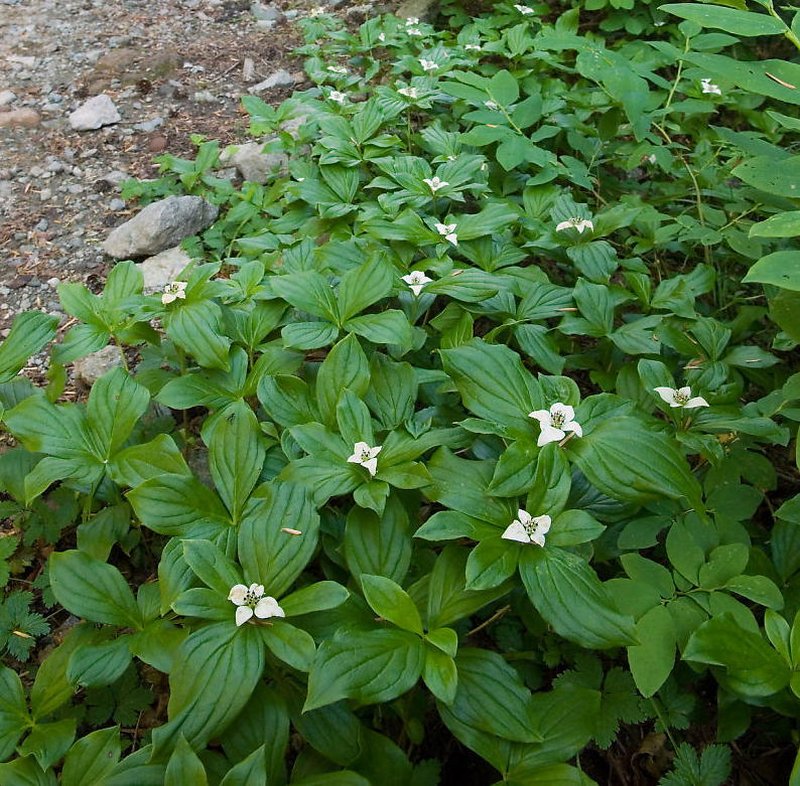
original: JohnHarvey; derivative:
Taxonomy
- Division:
- Magnoliophyta | - Flowering plants
- Family:
- Cornaceae
- Genus:
- Cornus
- Species:
- Cornus canadensis
Growth Characteristics
- Life Cycle:
- Perennial
- Growth Habit:
- Forb/herb , Shrub , Subshrub
- Height:
- 6 in - 1 ft
- Light Requirements:
- Full Sun, Part Shade, Shade
- Drought Tolerance:
- Low
- Bloom Months:
- may, jun, jul, aug, sep
- Bloom Colors:
- White, Yellow, Green, Brown
- Ground Cover:
- Yes
- Lawn Substitute:
- Yes
- Evergreen Shrub:
- Yes
Native Range
United States: Alaska, Colorado, Connecticut, Iowa, Idaho, Illinois, Indiana, Massachusetts, Maryland, Maine, Michigan, Minnesota, Montana, North Dakota, New Hampshire, New Jersey, New Mexico, New York, Ohio, Oregon, Pennsylvania, Rhode Island, South Dakota, Virginia, Vermont, Washington, Wisconsin, West Virginia, Wyoming, Canada: Alberta, British Columbia, Manitoba, New Brunswick, Nova Scotia, Northwest Territories, Nunavut, Ontario, Prince Edward Island, Quebec, Saskatchewan, Yukon
Keystone Species Ranking
- Caterpillar Keystone:
- ★★☆☆☆ Based on number of butterfly and moth species using this genus as host plant (Source: National Wildlife Federation)
- Bee Keystone:
- ★★★★★ Based on number of native bee species using this genus for pollen and nectar (Source: National Wildlife Federation)
Host Plant for Caterpillars
Reported Fauna Sightings
Soil Requirements
- Soil Type:
- rich, well-drained loamy soil
- pH:
- 4.5 - 6.5 (acidic to slightly acidic)
- Drainage:
- excellent drainage required
- Moisture:
- consistently moist
- Notes:
- Prefers cool, shaded forest floors
Germination Information
Pre-treatment: Seeds are scarified using boiling water or H2S04 acid bath, then soaked in water. This is followed by a warm-moist stratification for 45 days and a cold-moist stratification for 90-140 days.
Establishment: Seeds are collected by hand from locally native plants. The drupes are hand collected in late August and early September when they turn orange-red. Seeds are tan at maturity. Fruits are collected in plastic bags are are kept refrigerated prior to cleaning. There was no appreciable difference in germination percentages between acid scarified seed/ 90 day cold, moist stratification vs. non-scarified seed/5 month cold, moist stratification.
Source: npn.rngr.net