
Cucamonga Manroot
Marah macrocarpus
- Native to:
- United States
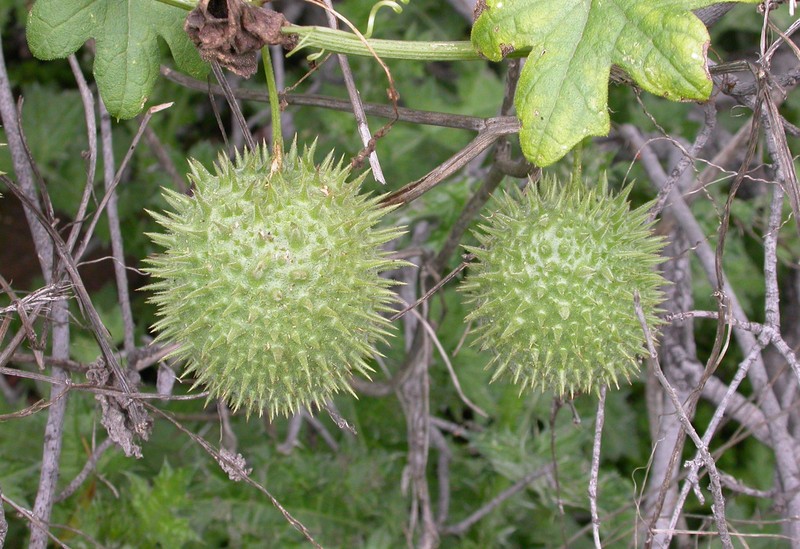
Copyright by Curtis Clark, licensed as noted
Taxonomy
- Division:
- Magnoliophyta | - Flowering plants
- Family:
- Cucurbitaceae
- Genus:
- Marah (Kellogg | - m)
- Species:
- Marah macrocarpus
- USDA Symbol:
- MAMA8
Growth Characteristics
- Life Cycle:
- Perennial
- Growth Habit:
- Forb/herb , Vine
- Height:
- 600 cm
- Light Requirements:
- Full Sun
- Drought Tolerance:
- High
- Bloom Months:
- feb,mar,apr,may
- Bloom Colors:
- white
Wildlife Benefits
- Butterflies & Moths:
- ★☆☆☆☆ Documented Lepidoptera association (GBIF)
- Caterpillars:
- ★☆☆☆☆ Recorded caterpillar host plant (HOSTS Database)
Host Plant for Caterpillars
Eupithecia shirleyata, Leconte's haploa (Haploa lecontei), Spilosoma vestalis
Garden & Ecology Notes
- Wildlife Value:
- birds, small mammals
- Deer Resistant:
- Yes
- Fire Ecology:
- Fire adapted — tolerates or benefits from fire
- Fire Notes:
- Resprouts from a large underground tuber after fire.
Soil Requirements
- Soil Type:
- sandy, well-drained, nutrient-poor soil
- pH:
- 6.0 - 7.5 (slightly acidic to neutral)
- Drainage:
- excellent drainage required
- Moisture:
- dry to moderate
- Notes:
- Commonly found in coastal sage scrub and chaparral habitats.
Propagation & Germination
- Stratification:
- Cold/moist stratification required — 30–60 days
- Scarification:
- Seed coat scarification required before sowing
- Germination Time:
- 14–60 days
- Notes:
- Seeds require scarification (nicking or sanding) followed by cold stratification for 30-60 days to break dormancy.
Pre-treatment: Seeds treated with dry heat at 120 C for 5 minutes resulted in decreased germination.
Establishment: The plant is found within the mattoral vegetation association of California. Avoid pre-treatment with dry heat as it decreases germination.
Source: npn.rngr.net