
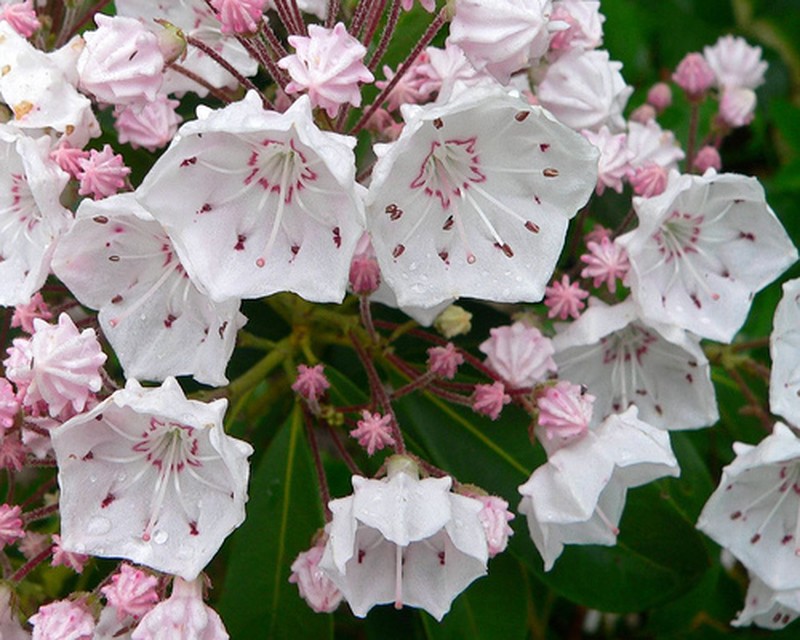
Mountain Laurel
Kalmia latifolia
Taxonomy
- Division:
- Magnoliophyta | - Flowering plants
- Family:
- Ericaceae
- Genus:
- Kalmia
- Species:
- Kalmia latifolia
Growth Characteristics
- Life Cycle:
- Perennial
- Growth Habit:
- Shrub , Tree
- Height:
- 20-40 ft
- Light Requirements:
- Part Shade
- Drought Tolerance:
- Medium
- Bloom Months:
- jun, jul
- Bloom Colors:
- White, Pink
- Evergreen Shrub:
- Yes
- Landscaping Shrub:
- Yes
Native Range
United States: Alabama, Connecticut, District of Columbia, Delaware, Florida, Georgia, Indiana, Kentucky, Louisiana, Massachusetts, Maryland, Maine, Mississippi, North Carolina, New Hampshire, New Jersey, New York, Ohio, Pennsylvania, Rhode Island, South Carolina, Tennessee, Virginia, Vermont, West Virginia
Keystone Species Ranking
- Caterpillar Keystone:
- ★★★☆☆ Based on number of butterfly and moth species using this genus as host plant (Source: National Wildlife Federation)
- Bee Keystone:
- ★★★★★ Based on number of native bee species using this genus for pollen and nectar (Source: National Wildlife Federation)
Host Plant for Caterpillars
Reported Fauna Sightings
Soil Requirements
- Soil Type:
- sandy, acidic, nutrient-poor soil
- pH:
- 4.5 - 6.0 (acidic)
- Drainage:
- excellent drainage required
- Moisture:
- consistently moist
- Notes:
- prefers soils found in woodland and heathland areas
Germination Information
Pre-treatment: Mix 0.05 to 0.1 gram of seed with 4 to 8 grams of talc and sift over the surface of media. Alternatively, seeds can be cold stratified for 56 days.
Establishment: Most mortality occurs during the slow-growth, 2-leaf period when seedlings can become necrotic and die from too much water, deteriorating media, too low/high media temperature, fungus and insects. The plant is found in acid soils, mostly rocky or sandy, within temperate deciduous forests of North America.
Source: npn.rngr.net