
Cranberry
Vaccinium macrocarpon
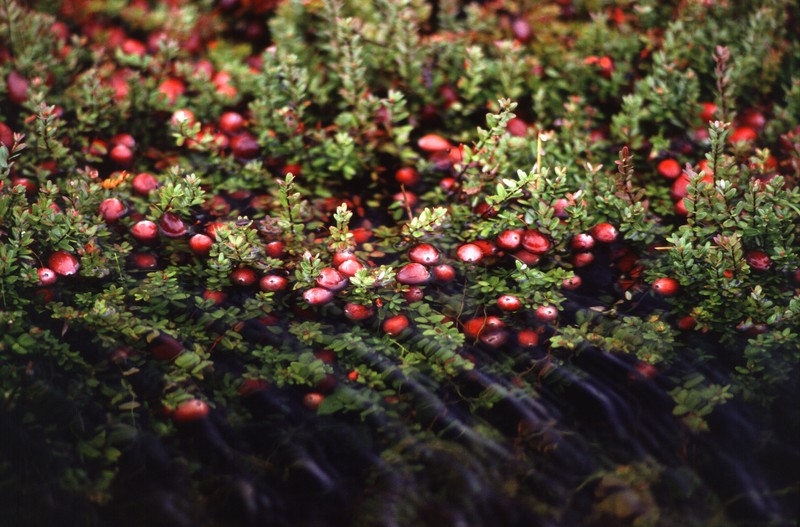
Photo by Keith Weller
Taxonomy
- Division:
- Magnoliophyta | - Flowering plants
- Family:
- Ericaceae
- Genus:
- Vaccinium
- Species:
- Vaccinium macrocarpon
Growth Characteristics
- Life Cycle:
- Perennial
- Growth Habit:
- Shrub , Subshrub
- Height:
- 6 in - 1 ft
- Light Requirements:
- Part Shade
- Drought Tolerance:
- High
- Bloom Months:
- may, jun, jul
- Bloom Colors:
- White, Pink
- Evergreen Shrub:
- Yes
Native Range
United States: California, Connecticut, Delaware, Illinois, Indiana, Massachusetts, Maryland, Maine, Michigan, Minnesota, North Carolina, New Hampshire, New Jersey, New York, Ohio, Oregon, Pennsylvania, Rhode Island, Tennessee, Virginia, Vermont, Washington, Wisconsin, West Virginia, Canada: British Columbia, New Brunswick, Nova Scotia, Northwest Territories, Ontario, Prince Edward Island, Quebec
Keystone Species Ranking
- Caterpillar Keystone:
- ★☆☆☆☆ Based on number of butterfly and moth species using this genus as host plant (Source: National Wildlife Federation)
- Bee Keystone:
- ★★★★☆ Based on number of native bee species using this genus for pollen and nectar (Source: National Wildlife Federation)
Host Plant for Caterpillars
American Swordgrass Moth (Xylena nupera), Apiate Epiglaea (Epiglaea apiata), Apple Sphinx (Sphinx gordius), Apple Sphinx (Sphinx "gordius"), Armyworm moth (Pseudaletia unipuncta), Black cutworm (Agrotis ipsilon), Buck Moth (Hemileuca maia), Celery Looper (Anagrapha falcifera), Chain-lined geometer moth (Cingilia catenaria), Cocoa Emerald (Ematurga amitaria), common eupithecia (Eupithecia miserulata), common gray (Anavitrinella pampinaria), Coptodisca negligens, cranberry fruitworm (Acrobasis vaccinii), crispate flannel moth (Megalopyge crispata), Curve-toothed geometer (Eutrapela clemataria), Deterred Dart (Euxoa detersa), Dichomeris vacciniella, Fall armyworm (Spodoptera frugiperda), Grapholita conversana, Gypsy moth (Lymantria dispar), Hemipachnobia monochromataea, Hyppa xylinoides, Nevada buckmoth (Hemileuca nevadensis-complex), New England buck moth (Hemileuca lucina), Orthotaenia undulana, Rhopobota finitimana, Rhopobota unipunctana, Setaceous Hebrew Character (Xestia c-nigrum), silky sallow (Chaetaglaea sericea), Southern armyworm (Spodoptera eridania), sparganothis fruitworm moth (Sparganothis sulfureana), Stigmella corylifoliella, sulphur moth (Hesperumia sulphuraria), topiary grass-veneer (Chrysoteuchia topiaria), tritona dagger moth (Acronicta tritona), Variable Owlet Moth (Phalaenostola metonalis), Wild Cherry Sphinx (Sphinx drupiferarum), yellow-headed fireworm (Acleris minuta), zebra caterpillar moth (Melanchra picta), Epidemia epixanthe
Reported Fauna Sightings
Bees: Black-tailed bumble bee (Bombus melanopygus), Black-tailed bumble bee (Bombus melanopygus), Bombus terricola (Bombus terricola), Bombus terricola (Bombus terricola), Common eastern bumble bee (Bombus impatiens), Common eastern bumble bee (Bombus impatiens), Tri-colored bumble bee (Bombus ternarius), Tri-colored bumble bee (Bombus ternarius) Butterflies:Appalachian Eyed Brown (Lethe appalachia), Appalachian Eyed Brown (Lethe appalachia), Arctic White (Pieris angelika), Arctic White (Pieris angelika), Baltimore Checkerspot (Euphydryas phaeton), Baltimore Checkerspot (Euphydryas phaeton), Bog Copper (Lycaena epixanthe), Bog Copper (Lycaena epixanthe), (Pieris rapae), (Pieris rapae), Canadian Tiger Swallowtail (Papilio canadensis), Canadian Tiger Swallowtail (Pterourus canadensis), Common Wood-Nymph (Cercyonis pegala), Common Wood-Nymph (Cercyonis pegala), Delaware Skipper (Anatrytone logan), Delaware Skipper (Anatrytone logan), Dun Skipper (Euphyes vestris), Dun Skipper (Euphyes vestris), Eastern Tailed-Blue (Cupido comyntas), Eastern Tailed-Blue (Cupido comyntas), Eastern Tiger Swallowtail (Pterourus glaucus), Eastern Tiger Swallowtail (Pterourus glaucus), Field Crescent (Phyciodes pulchella), Field Crescent (Phyciodes pulchella), Field Skipper (Atalopedes campestris), Field Skipper (Atalopedes campestris), Gray Hairstreak (Strymon melinus), Gray Hairstreak (Strymon melinus), Horace's Duskywing (Gesta Evans), Lesser Fritillary (Boloria Moore), Milbert's Tortoiseshell (Aglais milberti), Milbert's Tortoiseshell (Aglais milberti), Northern Azure (Celastrina lucia), Northern Azure (Celastrina lucia), Northern Broken-Dash (Polites egeremet), Pearl Crescent (Phyciodes tharos), Pearl Crescent (Phyciodes tharos), Red Admiral (Vanessa atalanta), Red-spotted Admiral (Limenitis arthemis), Red-spotted Admiral (Limenitis arthemis), Silvery Blue (Glaucopsyche lygdamus), Silvery Blue (Glaucopsyche lygdamus), Small Copper (Lycaena phlaeas), Striped Hairstreak (Satyrium liparops), Striped Hairstreak (Satyrium liparops)
Soil Requirements
- Soil Type:
- sandy, acidic, nutrient-poor soil
- pH:
- 4.0 - 5.5 (strongly acidic to moderately acidic)
- Drainage:
- excellent drainage required
- Moisture:
- consistently moist
- Notes:
- Commonly found in bogs and wetlands.
Germination Information
Pre-treatment: Cold-moist stratification for 30 days at 1–5°C (34–41°F).; then Cold-moist stratification for 60 days.
Notes: Seeds require light for germination.
Source: OpenAI GPT-4o