
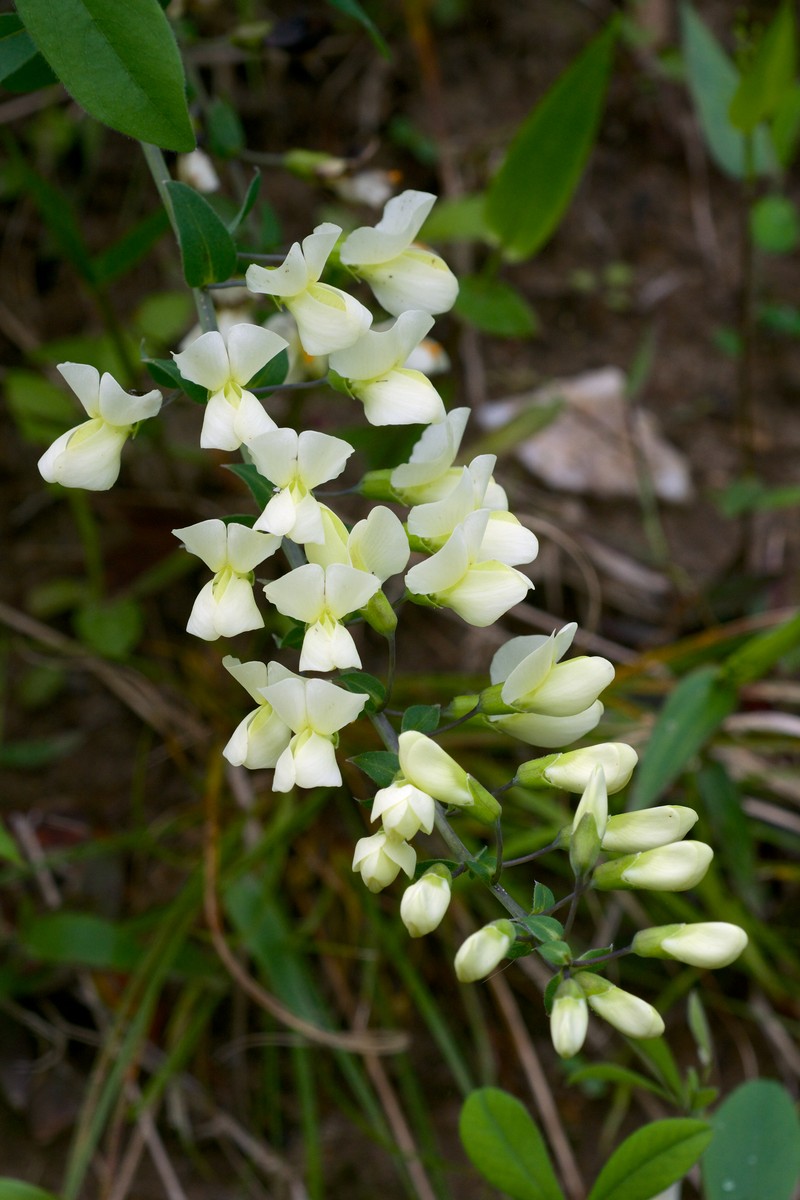
Longbract Wild Indigo
Baptisia bracteata
Taxonomy
- Division:
- Magnoliophyta | - Flowering plants
- Family:
- Fabaceae
- Genus:
- Baptisia
- Species:
- Baptisia bracteata
Growth Characteristics
- Life Cycle:
- Perennial
- Growth Habit:
- Forb/herb
- Height:
- 2-3 ft
- Light Requirements:
- Full Sun, Part Shade
- Drought Tolerance:
- High
- Bloom Months:
- may, jun
- Bloom Colors:
- White, Yellow
Native Range
United States: Alabama, Arkansas, Georgia, Iowa, Illinois, Indiana, Kansas, Kentucky, Louisiana, Massachusetts, Michigan, Minnesota, Missouri, Mississippi, North Carolina, Nebraska, New Jersey, Oklahoma, South Carolina, South Dakota, Tennessee, Texas, Wisconsin
Keystone Species Ranking
- Caterpillar Keystone:
- ★★★☆☆ Based on number of butterfly and moth species using this genus as host plant (Source: National Wildlife Federation)
Host Plant for Caterpillars
Wild Indigo Duskywing (Erynnis baptisiae)
Reported Fauna Sightings
Bees: American bumble bee (Bombus pensylvanicus), American bumble bee (Bombus pensylvanicus), Black and gold bumble bee (Bombus auricomus), Black and gold bumble bee (Bombus auricomus), Brown-belted bumble bee (Bombus griseocollis), Brown-belted bumble bee (Bombus griseocollis), Yellow bumble bee (Bombus fervidus), Yellow bumble bee (Bombus fervidus)
Soil Requirements
- Soil Type:
- well-drained, sandy or loamy soil
- pH:
- 5.5 - 7.0 (slightly acidic to neutral)
- Drainage:
- excellent drainage required
- Moisture:
- dry to moderate
Germination Information
Pre-treatment: Mix seed with equal amounts of vermiculite and lightly dampen in a plastic bag or container. Store this seed for 3-4 months in a cold room of 34-36 degrees F.
Establishment: Seed is collected by hand from nursery stock. The plant flowers most of May and June. Seed is harvested in the beginning of August.
Source: npn.rngr.net