
Crimson Clover
Trifolium incarnatum
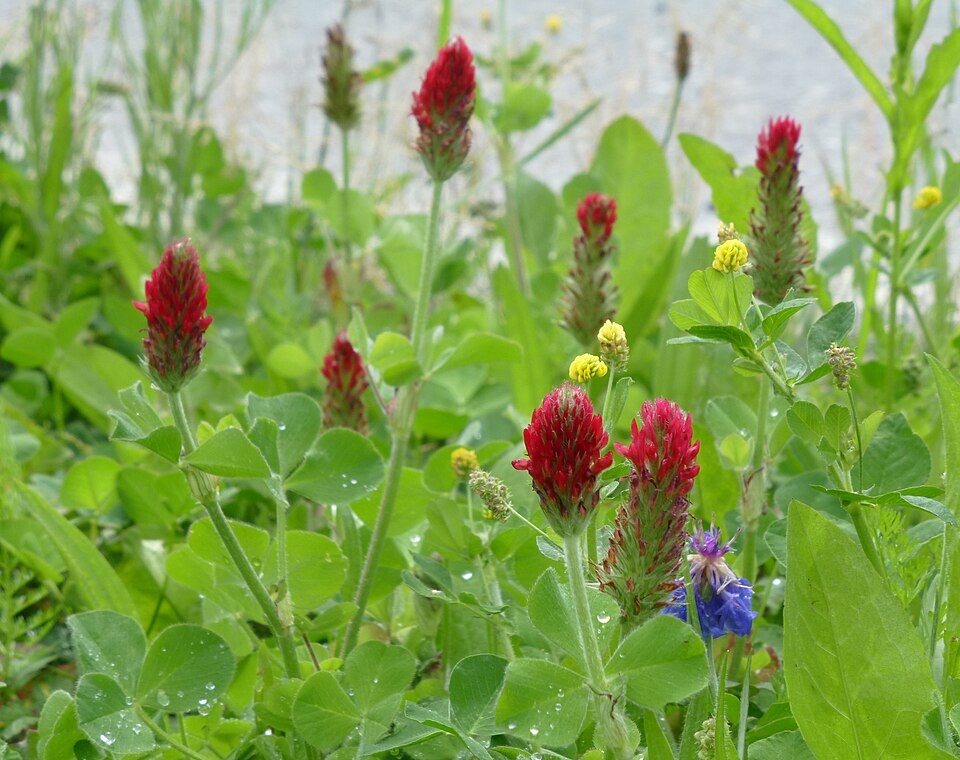
Taxonomy
- Division:
- Magnoliophyta | - Flowering plants
- Family:
- Fabaceae
- Genus:
- Trifolium
- Species:
- Trifolium incarnatum
Growth Characteristics
- Life Cycle:
- Annual
- Growth Habit:
- Forb/herb
- Height:
- 1-2 ft
- Light Requirements:
- Full Sun
- Drought Tolerance:
- High
- Bloom Months:
- mar, apr, may
- Bloom Colors:
- red
- Ground Cover:
- Yes
- Landscaping Shrub:
- Yes
Native Range
United States: Alabama, Arkansas, California, Connecticut, District of Columbia, Delaware, Florida, Georgia, Hawaii, Iowa, Idaho, Illinois, Kansas, Kentucky, Louisiana, Massachusetts, Maryland, Maine, Michigan, Minnesota, Missouri, Mississippi, Montana, North Carolina, North Dakota, Nebraska, New Hampshire, New Jersey, New Mexico, New York, Ohio, Oklahoma, Oregon, Pennsylvania, Rhode Island, South Carolina, South Dakota, Tennessee, Texas, Virginia, Vermont, Washington, Wisconsin, West Virginia, Canada: British Columbia, Manitoba, Ontario
Keystone Species Ranking
- Bee Keystone:
- ★★★★☆ Based on number of native bee species using this genus for pollen and nectar (Source: National Wildlife Federation)
Host Plant for Caterpillars
Grapholita interstinctana, Green Cloverworm Moth (Hypena scabra), Gray Hairstreak (Strymon melinus)
Reported Fauna Sightings
Bees: American bumble bee (Bombus pensylvanicus), American bumble bee (Bombus pensylvanicus), Black-tailed bumble bee (Bombus melanopygus), Black-tailed bumble bee (Bombus melanopygus), Brown-belted bumble bee (Bombus griseocollis), Brown-belted bumble bee (Bombus griseocollis), Common eastern bumble bee (Bombus impatiens), Common eastern bumble bee (Bombus impatiens), Fuzzy-horned bumble bee (Bombus mixtus), Fuzzy-horned bumble bee (Bombus mixtus), Half-black bumble bee (Bombus vagans), Half-black bumble bee (Bombus vagans), Northern amber bumble bee (Bombus borealis), Northern amber bumble bee (Bombus borealis), Obscure bumble bee (Bombus caliginosus), Obscure bumble bee (Bombus caliginosus), Two-form bumble bee (Bombus bifarius), Two-form bumble bee (Bombus bifarius), Yellow bumble bee (Bombus fervidus), Yellow bumble bee (Bombus fervidus), Yellow head bumble bee (Bombus flavifrons), Yellow head bumble bee (Bombus flavifrons), Yellow-faced bumble bee (Bombus vosnesenskii), Yellow-faced bumble bee (Bombus vosnesenskii) Butterflies:American Lady (Vanessa virginiensis), Black Swallowtail (Papilio polyxenes), Carolina Satyr (Hermeuptychia sosybius), Carolina Satyr (Hermeuptychia sosybius), Cloudless Sulphur (Phoebis sennae), Cloudless Sulphur (Phoebis sennae), Dreamy Duskywing (Erynnis icelus), Dreamy Duskywing (Erynnis icelus), Eastern Tailed-Blue (Cupido comyntas), Eastern Tailed-Blue (Cupido comyntas), Eastern Tiger Swallowtail (Pterourus glaucus), Eastern Tiger Swallowtail (Pterourus glaucus), Field Skipper (Atalopedes campestris), Field Skipper (Atalopedes campestris), Gray Hairstreak (Strymon melinus), Gray Hairstreak (Strymon melinus), Horace's Duskywing (Gesta Evans), Pearl Crescent (Phyciodes tharos), Pearl Crescent (Phyciodes tharos), Pipevine Swallowtail (Battus philenor), Pipevine Swallowtail (Battus philenor), Sachem (Atalopedes Scudder), Silver-spotted Skipper (Epargyreus clarus), Silver-spotted Skipper (Epargyreus clarus), Spicebush Swallowtail (Pterourus troilus)
Soil Requirements
- Soil Type:
- fertile, well-drained loamy soil
- pH:
- 6.0 - 7.5 (slightly acidic to neutral)
- Drainage:
- good drainage preferred
- Moisture:
- consistently moist
- Notes:
- native to temperate regions with mild winters