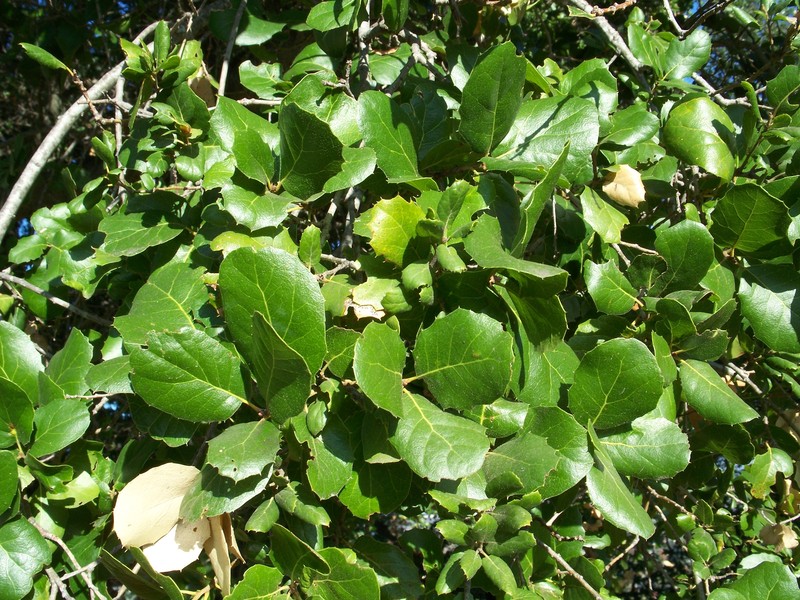
Taxonomy
- Division:
- Magnoliophyta | - Flowering plants
- Family:
- Fagaceae
- Genus:
- Quercus
- Species:
- Quercus agrifolia
Growth Characteristics
- Life Cycle:
- Perennial
- Growth Habit:
- Shrub , Tree
- Height:
- More than 40 ft
- Light Requirements:
- Full Sun, Part Shade
- Drought Tolerance:
- Medium
- Bloom Months:
- mar, apr, may
- Bloom Colors:
- Red, Yellow, Green
- Evergreen Shrub:
- Yes
Native Range
United States: California
Keystone Species Ranking
- Caterpillar Keystone:
- ★☆☆☆☆
Based on number of butterfly and moth species using this genus as host plant (Source: National Wildlife Federation)
Host Plant for Caterpillars
Acrocercops insulariella, Aholibah Underwing (Catocala aholibah), Bucculatrix albertiella, California oakworm (Phryganidia californica), Caloptilia agrifoliella, Caloptilia diversilobiella, Caloptilia reticulata, Cameraria agrifoliella, Cameraria anomala, Cameraria wislizeniella, Chimoptesis chrysopyla, Chionodes acrina, Chionodes chrysopyla, Chionodes occidentella, Chionodes raspyon, Chionodes vanduzeei, Coptodisca powellella, Cosmia calami, Decodes fragariana, Dyseriocrania auricyanea, Epinotia emarginana, Eriocraniella aurosparsella, Eriocraniella xanthocara, Evippe sp., fruit-tree leafroller (Archips argyrospila), Gloveria medusa, habrosana leafroller moth (Pseudexentera habrosana), Hemihyalea edwardsii, Henricus umbrabasanus, Hydriomena albifasciata, Mesogona subcuprea, Nemoria glaucomarginaria, Neurobathra bohartiella, Nevada buck moth (Hemileuca nevadensis), oak winter moth (Hydriomena nubilofasciata), Obliquebanded leafroller (Choristoneura rosaceana), orange tortrix moth (Argyrotaenia franciscana), orange tortrix moth (Argyrotaenia citrana), Orthosia pacifica, Pacific tent caterpillar (Malacosoma constricta), Phyllonorycter antiochella, Phyllonorycter inusitatella, Phyllonorycter sandraella, Polyphemus moth (Antheraea polyphemus), Pseudoglaea olivata, Rectiostoma fernaldella, Recurvaria glinax, Stigmella variella, Stilbosis dulcedo, Synanthedon resplendens, Telphusa sedulitella, Tischeria discreta, Trachycera caliginella, Vespina quercivora, Western tent caterpillar (Malacosoma californica), Western tussock moth (Orgyia vetusta), Xenolechia staspa, Ypsolopha cervella, Bredow's sister (Adelpha bredowii), Mournful Duskywing (Erynnis tristis), Propertius Duskywing (Erynnis propertius)
Reported Fauna Sightings
Hoverflies: Syrphid Fly; Coast Live Oak (Syrphus opinator), Syrphid Fly; Coast Live Oak (Syrphus opinator)
Soil Requirements
- Soil Type:
- well-drained, sandy loam or clay
- pH:
- 5.5 - 7.5 (slightly acidic to neutral)
- Drainage:
- excellent drainage required
- Moisture:
- dry to moderate
- Notes:
- native to coastal regions with seasonal rainfall
Germination Information
Pre-treatment: Soak clean acorns overnight in fresh water. Drain and rinse in a 5% bleach solution for 1 minute. Rinse. Place seeds in a plastic freezer bag with an equal amount of dry perlite. Keep in refrigerator at 15C. Check for germination after 1 month.
Establishment: Acorns are collected between September 1st and December 15th. Mature acorns are brown. Collect acorns as soon as base of acorn around the cup turns brown. Q. agrifolia is found from lower California to central California in the coast range below 1000 meters elevation and commonly found in valleys and slopes below 3,000 feet elevation; from coast ranges from Sonoma County to San Diego County to Lower California.
Source: npn.rngr.net