
Elkweed
Frasera speciosa
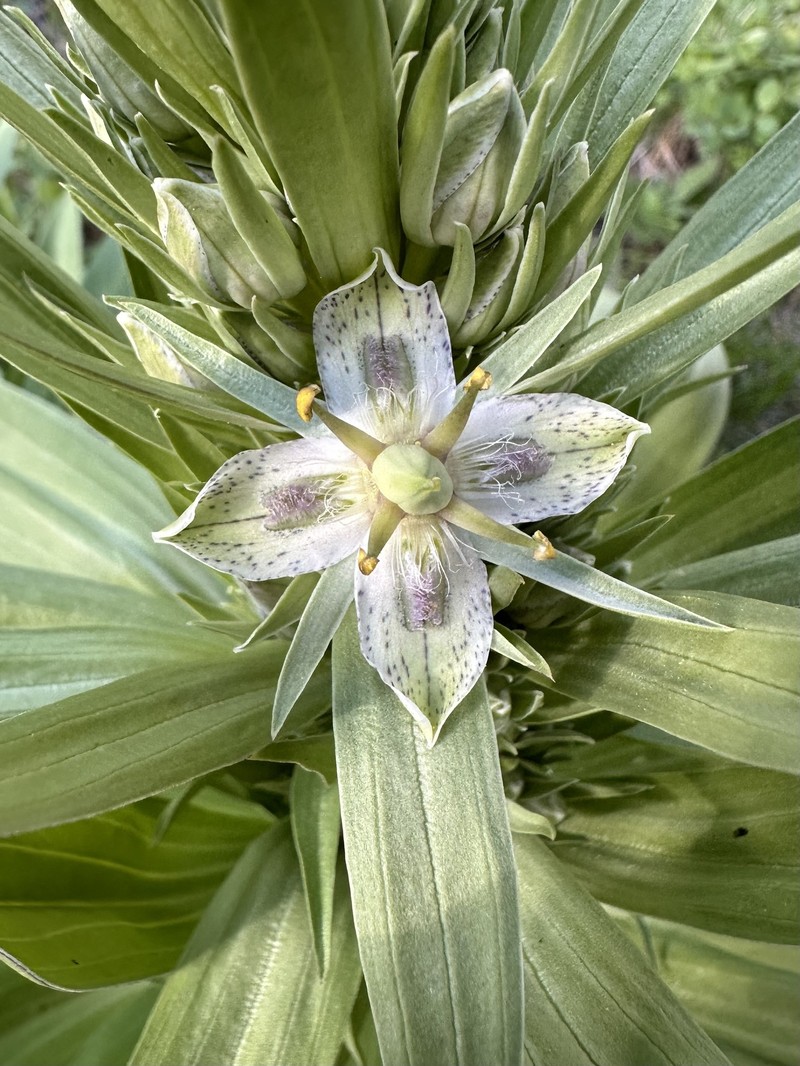
Taxonomy
- Division:
- Magnoliophyta | - Flowering plants
- Family:
- Gentianaceae
- Genus:
- Frasera
- Species:
- Frasera speciosa
Growth Characteristics
- Life Cycle:
- Perennial
- Growth Habit:
- Forb/herb
- Height:
- 8-12 ft
- Light Requirements:
- Full Sun
- Drought Tolerance:
- High
- Bloom Months:
- may, jun, jul, aug
- Bloom Colors:
- White, Green
Native Range
United States: Arizona, California, Colorado, Idaho, Montana, New Mexico, Nevada, Oregon, South Dakota, Texas, Utah, Washington, Wyoming
Host Plant for Caterpillars
verbena bud moth (Endothenia hebesana)
Reported Fauna Sightings
Bees: Black-tailed bumble bee (Bombus melanopygus), Black-tailed bumble bee (Bombus melanopygus), Central bumble bee (Bombus centralis), Central bumble bee (Bombus centralis), Forest bumble bee (Bombus sylvicola), Forest bumble bee (Bombus sylvicola), Fuzzy-horned bumble bee (Bombus mixtus), Fuzzy-horned bumble bee (Bombus mixtus), Indiscriminate cuckoo bumble bee (Bombus insularis), Indiscriminate cuckoo bumble bee (Bombus insularis), Nevada bumble bee (Bombus nevadensis), Nevada bumble bee (Bombus nevadensis), Red-belted bumble bee (Bombus rufocinctus), Red-belted bumble bee (Bombus rufocinctus), Two-form bumble bee (Bombus bifarius), Two-form bumble bee (Bombus bifarius), Western bumble bee (Bombus occidentalis), Western bumble bee (Bombus occidentalis), White-shouldered bumble bee (Bombus appositus), White-shouldered bumble bee (Bombus appositus), Yellow bumble bee (Bombus fervidus), Yellow bumble bee (Bombus fervidus), Yellow head bumble bee (Bombus flavifrons), Yellow head bumble bee (Bombus flavifrons), Yellow-faced bumble bee (Bombus vosnesenskii), Yellow-faced bumble bee (Bombus vosnesenskii)
Soil Requirements
- Soil Type:
- rich, well-drained loamy soil
- pH:
- 5.5 - 7.5 (slightly acidic to neutral)
- Drainage:
- excellent drainage required
- Moisture:
- dry to moderate
- Notes:
- prefers open meadows and forest edges
Germination Information
Pre-treatment: Seeds are placed in cold moist stratification for 112 days.
Establishment: C. foliosum is found throughout the western United States in moist meadows and upland forests.
Source: npn.rngr.net