
White Sage
Salvia apiana
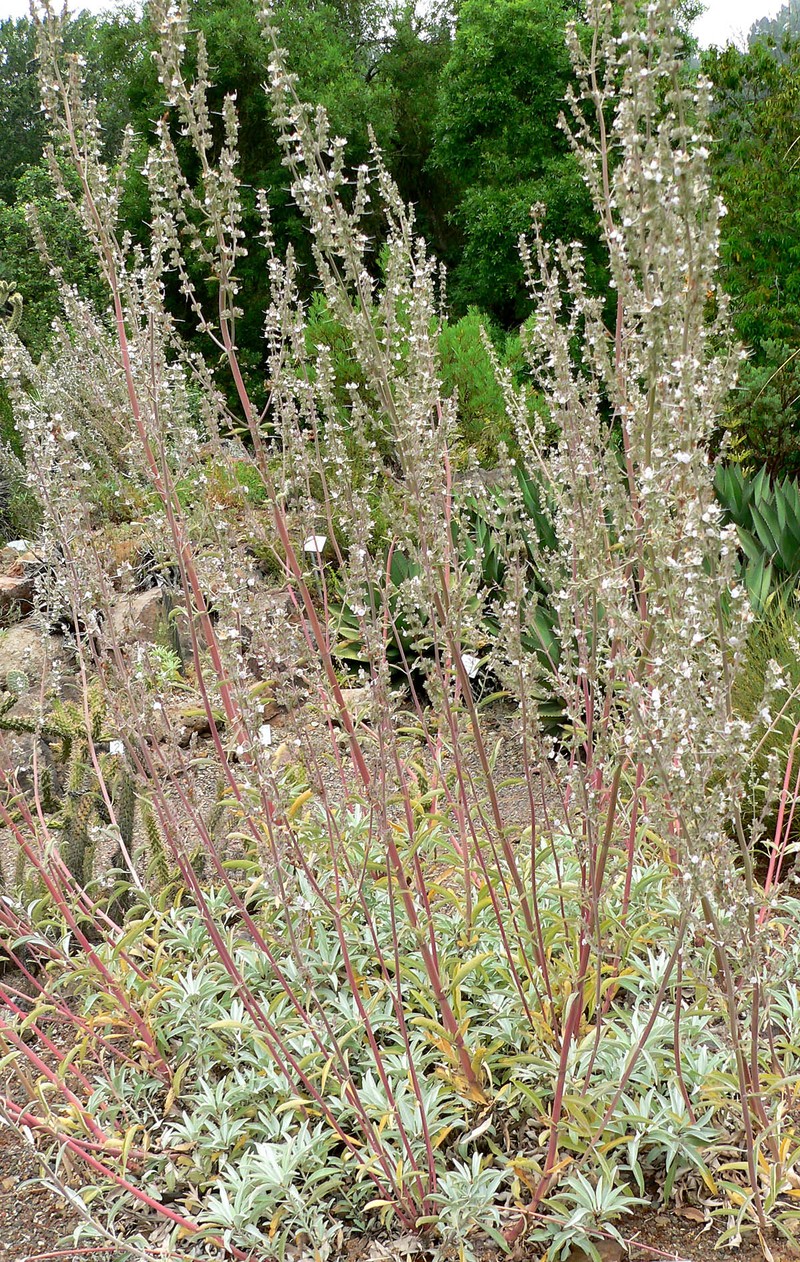
Taxonomy
- Division:
- Magnoliophyta | - Flowering plants
- Family:
- Lamiaceae
- Genus:
- Salvia
- Species:
- Salvia apiana
Growth Characteristics
- Life Cycle:
- Perennial
- Growth Habit:
- Subshrub
- Height:
- 4-6 ft
- Light Requirements:
- Full Sun
- Drought Tolerance:
- High
- Bloom Months:
- apr, may, jun, jul
- Bloom Colors:
- White, Purple
- Evergreen Shrub:
- Yes
- Landscaping Shrub:
- Yes
Native Range
United States: California
Host Plant for Caterpillars
Barnes' dart moth (Abagrotis barnesi), Bucculatrix taeniola
Reported Fauna Sightings
Bees: American bumble bee (Bombus pensylvanicus), American bumble bee (Bombus pensylvanicus), Black-tailed bumble bee (Bombus melanopygus), Black-tailed bumble bee (Bombus melanopygus), Crotch bumble bee (Bombus crotchii), Crotch bumble bee (Bombus crotchii), Yellow bumble bee (Bombus fervidus), Yellow bumble bee (Bombus fervidus), Yellow head bumble bee (Bombus flavifrons), Yellow head bumble bee (Bombus flavifrons), Yellow-faced bumble bee (Bombus vosnesenskii), Yellow-faced bumble bee (Bombus vosnesenskii)
Soil Requirements
- Soil Type:
- sandy, nutrient-poor, well-drained soil
- pH:
- 6.0 - 8.0 (slightly acidic to neutral)
- Drainage:
- excellent drainage required
- Moisture:
- dry to moderate
- Notes:
- Native to arid regions; prefers dry conditions
Germination Information
Pre-treatment: For cuttings, recut at the base, remove lower leaves, dip into a Physan disinfectant, and treat with Hormex #3 rooting powder. For seeds, use a 3 minute 5% bleach solution to surface sterilize seed coats prior to sowing.
Establishment: Cuttings are collected in late April while seeds are collected when fully matured, typically in July and August. White Sage is commonly found in southern California and the Channel islands.
Source: npn.rngr.net