
Hollyhock
Alcea rosea
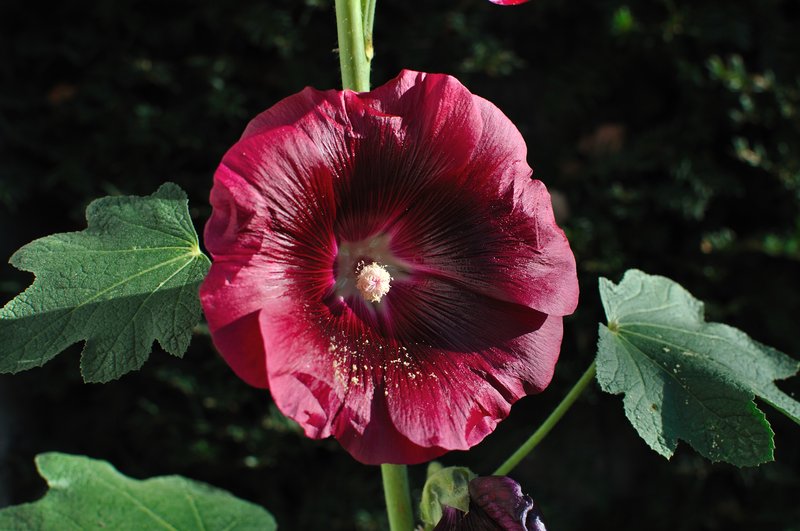
Taxonomy
- Division:
- Magnoliophyta | - Flowering plants
- Family:
- Malvaceae
- Genus:
- Alcea
- Species:
- Alcea rosea
Growth Characteristics
- Life Cycle:
- Biennial | Perennial
- Growth Habit:
- Forb/herb
- Height:
- 8-12 ft
- Light Requirements:
- Full Sun
- Drought Tolerance:
- Medium
- Bloom Months:
- jun, aug
- Bloom Colors:
- pink, purple, red, white, yellow
Native Range
United States: California, Colorado, Connecticut, District of Columbia, Delaware, Florida, Georgia, Iowa, Idaho, Illinois, Indiana, Kansas, Kentucky, Massachusetts, Maryland, Michigan, Minnesota, Missouri, Mississippi, Montana, North Carolina, North Dakota, Nebraska, New Jersey, New Mexico, Nevada, New York, Ohio, Oregon, Pennsylvania, Puerto Rico, Rhode Island, South Dakota, Tennessee, Texas, Utah, Virginia, Vermont, Washington, Wisconsin, West Virginia, Wyoming, Canada: Manitoba, New Brunswick, Ontario, Quebec
Host Plant for Caterpillars
Bucculatrix quadrigemina, Burdock Borer (Papaipema cataphracta), Cabbage looper (Trichoplusia ni), Celery Looper (Anagrapha falcifera), clandestine dart (Spaelotis clandestina), Common Looper Moth (Autographa precationis), Cotton looper (Anomis flava), cotton tipworm (Crocidosema plebejana), European corn borer (Ostrinia nubilalis), Fall armyworm (Spodoptera frugiperda), Fall webworm (Hyphantria cunea), glassy cutworm (Apamea devastator), Lophoplusia pterylota, Pink bollworm (Pectinophora gossypiella), Platyedra subcinerea, Purple Arches (Agrochola purpurea), Red-banded leafroller (Argyrotaenia velutinana), Southern armyworm (Spodoptera eridania), stalk borer moth (Papaipema nebris), Tischeria omissa, Variegated cutworm (Peridroma saucia), Virginia Tiger Moth (Spilosoma virginica), Yellow scallop moth (Anomis erosa), Yellow Shoulder (Acontia aprica), Common streaky-skipper (Celotes nessus), Northern White-Skipper (Heliopetes ericetorum), Painted Lady (Vanessa cardui), West Coast Lady (Vanessa annabella)
Reported Fauna Sightings
Bees: American bumble bee (Bombus pensylvanicus), American bumble bee (Bombus pensylvanicus), Brown-belted bumble bee (Bombus griseocollis), Brown-belted bumble bee (Bombus griseocollis), Central bumble bee (Bombus centralis), Central bumble bee (Bombus centralis), Common eastern bumble bee (Bombus impatiens), Common eastern bumble bee (Bombus impatiens), Confusing bumble bee (Bombus perplexus), Confusing bumble bee (Bombus perplexus), Fuzzy-horned bumble bee (Bombus mixtus), Fuzzy-horned bumble bee (Bombus mixtus), Half-black bumble bee (Bombus vagans), Half-black bumble bee (Bombus vagans), Hunt's bumble bee (Bombus huntii), Hunt's bumble bee (Bombus huntii), Indiscriminate cuckoo bumble bee (Bombus insularis), Indiscriminate cuckoo bumble bee (Bombus insularis), Morrison bumble bee (Bombus morrisoni), Morrison bumble bee (Bombus morrisoni), Nevada bumble bee (Bombus nevadensis), Nevada bumble bee (Bombus nevadensis), Red-belted bumble bee (Bombus rufocinctus), Red-belted bumble bee (Bombus rufocinctus), Two-spotted bumble bee (Bombus bimaculatus), Two-spotted bumble bee (Bombus bimaculatus), van Dyke bumble bee (Bombus vandykei), van Dyke bumble bee (Bombus vandykei), White-shouldered bumble bee (Bombus appositus), White-shouldered bumble bee (Bombus appositus), Yellow bumble bee (Bombus fervidus), Yellow bumble bee (Bombus fervidus), Yellow head bumble bee (Bombus flavifrons), Yellow head bumble bee (Bombus flavifrons), Yellow-faced bumble bee (Bombus vosnesenskii), Yellow-faced bumble bee (Bombus vosnesenskii)
Soil Requirements
- Soil Type:
- rich, well-drained loamy soil
- pH:
- 6.0 - 7.5 (slightly acidic to neutral)
- Drainage:
- excellent drainage required
- Moisture:
- dry to moderate
- Notes:
- native to areas with well-drained soils