
Sweet Fern
Comptonia peregrina
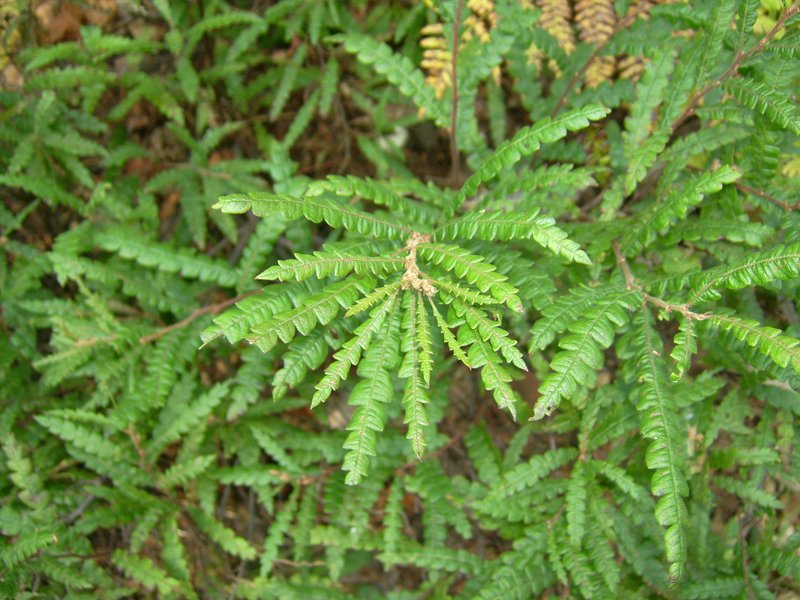
Taxonomy
- Division:
- Magnoliophyta | - Flowering plants
- Family:
- Myricaceae
- Genus:
- Comptonia
- Species:
- Comptonia peregrina
Growth Characteristics
- Life Cycle:
- Perennial
- Growth Habit:
- Shrub , Subshrub
- Height:
- 4-6 ft
- Light Requirements:
- Part Shade
- Drought Tolerance:
- High
- Bloom Months:
- may, jun, jul, aug
- Bloom Colors:
- White, Green
- Landscaping Shrub:
- Yes
Native Range
United States: Connecticut, District of Columbia, Delaware, Georgia, Illinois, Indiana, Kentucky, Massachusetts, Maryland, Maine, Michigan, Minnesota, North Carolina, New Hampshire, New Jersey, New York, Ohio, Pennsylvania, Rhode Island, South Carolina, Tennessee, Virginia, Vermont, Wisconsin, West Virginia, Canada: New Brunswick, Nova Scotia, Ontario, Prince Edward Island, Quebec
Keystone Species Ranking
- Caterpillar Keystone:
- ★★☆☆☆ Based on number of butterfly and moth species using this genus as host plant (Source: National Wildlife Federation)
Host Plant for Caterpillars
Agonopterix atrodorsella, Agonopterix walsinghamella, Apple Sphinx (Sphinx gordius), Apple Sphinx (Sphinx "gordius"), Argent and sable (Rheumaptera hastata), Aroga argutiola, Aroga trialbamaculella, Bay underwing (Catocala badia), Bayberry Leafroller Moth (Strepsicrates smithiana), Bent-line gray (Iridopsis larvaria), birch tubemaker moth (Acrobasis betulella), blackberry looper (Chlorochlamys chloroleucaria), blue spiderwort moth (Hypomecis buchholzaria), Bucculatrix paroptila, Caloptilia asplenifoliatella, Chain-lined geometer moth (Cingilia catenaria), Cleora sublunaria, Coelebs Underwing (Catocala coelebs), Coleophora comptoniella, Coleophora peregrinaevorella, Coleophora persimplexella, Coleophora serratella, Dichomeris bipunctella, Effecta Euchlaena Moth (Euchlaena effecta), Eufidonia discospilata, Eversmann's rustic (Actebia fennica), Exartema sp., False Crocus Geometer (Xanthotype urticaria), fruit-tree leafroller (Archips argyrospila), Gypsonoma fasciolana, Gypsy moth (Lymantria dispar), Io moth (Automeris io), Lacinipolia lorea, lanceolate dagger moth (Acronicta lanceolaria), least-marked euchlaena moth (Euchlaena irraria), Maple spanworm (Ennomos magnaria), Melanchra assimilis, Mesothea incertata, Norman's dart (Xestia normanianus), Olethreutes appendiceum, Olethreutes electrofuscum, Olethreutes glaciana, Orthotaenia undulana, Parornix peregrinaella, pawpaw sphinx (Dolba hyloeus), Peppered Moth (Biston betularia), Phyllonorycter comptoniella, Polia purpurissata, Prochoerodes transversata, Protolampra brunneicollis, Purple-lined sallow (Pyrrhia exprimens), red-banded leafroller (Acrobasis rubrifasciella), Red-fronted Emerald (Nemoria rubrifrontaria), Scallop moth (Cepphis armataria), Setaceous Hebrew Character (Xestia c-nigrum), Sphinx poecila, sweetfern geometer (Cyclophora pendulinaria), sweetfern leaf casebearer (Acrobasis comptoniella), sweetfern underwing (Catocala antinympha), Wavy-lined Emerald (Synchlora aerata), waxmyrtle wave moth (Cyclophora myrtaria), white slant-line (Tetracis cachexiata), white triangle tortrix (Clepsis persicana), white-fringed emerald (Nemoria mimosaria), Gray Hairstreak (Strymon melinus)
Soil Requirements
- Soil Type:
- sandy, acidic, nutrient-poor soil
- pH:
- 4.5 - 6.5 (acidic to slightly acidic)
- Drainage:
- excellent drainage required
- Moisture:
- dry to moderate
- Notes:
- thrives in poor, well-drained soils typical of pine barrens
Germination Information
Pre-treatment: Cold-moist stratification for 30 days at 1–5°C (34–41°F).
Source: OpenAI GPT-4o