
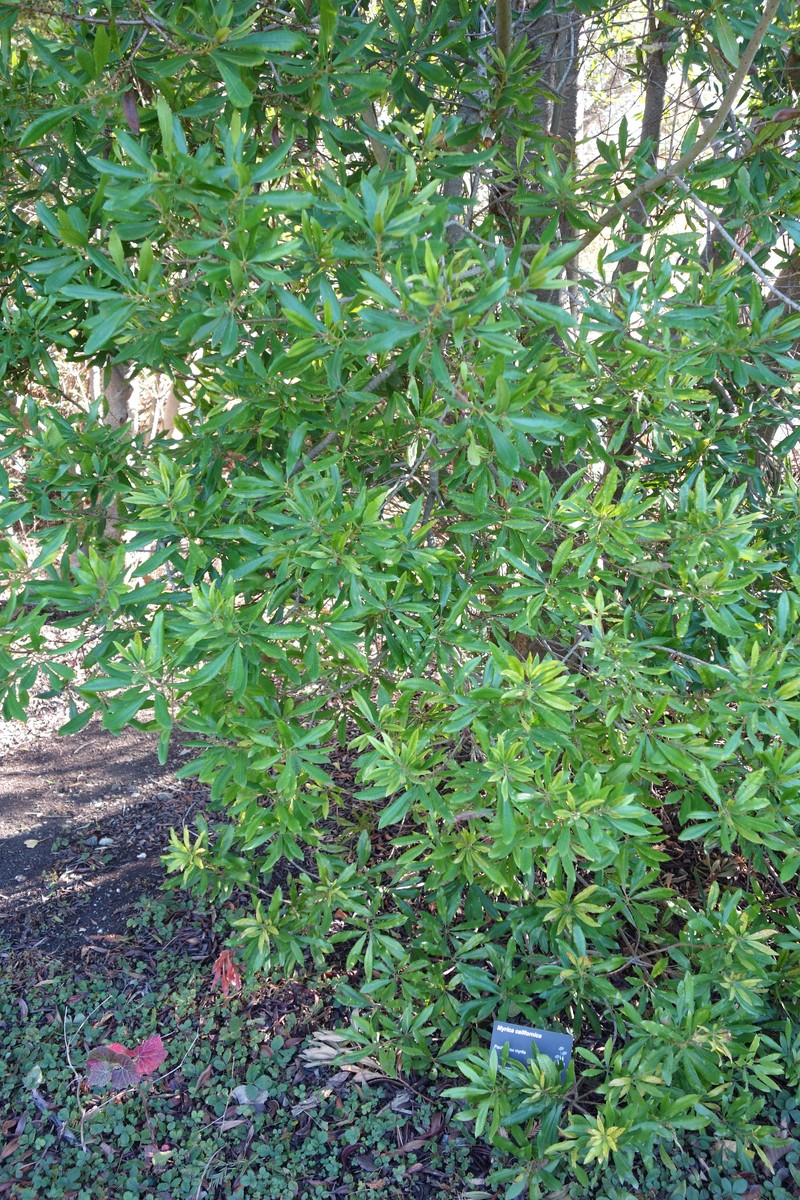
California Wax Myrtle
Myrica californica
Taxonomy
- Division:
- Magnoliophyta | - Flowering plants
- Family:
- Myricaceae
- Genus:
- Myrica
- Species:
- Myrica californica
Growth Characteristics
- Life Cycle:
- Perennial
- Growth Habit:
- Shrub , Tree
- Height:
- 20-40 ft
- Light Requirements:
- Full Sun, Part Shade
- Drought Tolerance:
- Low
- Bloom Months:
- apr, may, jun, jul
- Bloom Colors:
- White, Yellow
- Evergreen Shrub:
- Yes
- Landscaping Shrub:
- Yes
Native Range
United States: California, Oregon, Washington, Canada: British Columbia
Host Plant for Caterpillars
Bagworm moth (Thyridopteryx ephemeraeformis), Chain-lined geometer moth (Cingilia catenaria), crispate flannel moth (Megalopyge crispata), Olethreutes sericoranum, Red-humped caterpillar moth (Schizura concinna), red-lined emerald (Nemoria rubrolinearia), stinging rose caterpillar (Parasa indetermina), Telphusa sp., Yellow-shouldered Slug Moth (Lithacodes fasciola)
Soil Requirements
- Soil Type:
- rich, well-drained loamy soil
- pH:
- 5.0 - 7.0 (slightly acidic to neutral)
- Drainage:
- excellent drainage required
- Moisture:
- consistently moist
- Notes:
- thrives in coastal environments
Germination Information
Pre-treatment: For seeds: Soak in fresh water overnight, rinse in 5% bleach solution for 1 minute, place in plastic freezer bag with equal amount of ph neutral peat, and refrigerate at 40F for 2-3 months. For cuttings: Dip in mild bleach solution for 30 seconds, recut to 5 nodes in length, treat with Hormex (3000 ppm IBA) rooting powder, and strike in flats containing 3:1 Perlite/Vermiculite.
Establishment: Seeds are collected in January, while hardwood cuttings are collected between November 1st and January 31st. Transplant survival averages 75% for seeds and 60% for cuttings.
Source: npn.rngr.net