
Euphrasia officinalis
Euphrasia officinalis
- Native to:
- Albania, Austria, Baltic States, Belarus, Belgium, Bulgaria, Czechia-Slovakia, Denmark, Finland, France, Germany, Great Britain, Greece, Hungary, Ireland, Italy, Netherlands, NW. Balkan Pen., Poland, Romania, Russia, Spain, Sweden, Switzerland, Transcaucasus, Türkiye, Ukraine
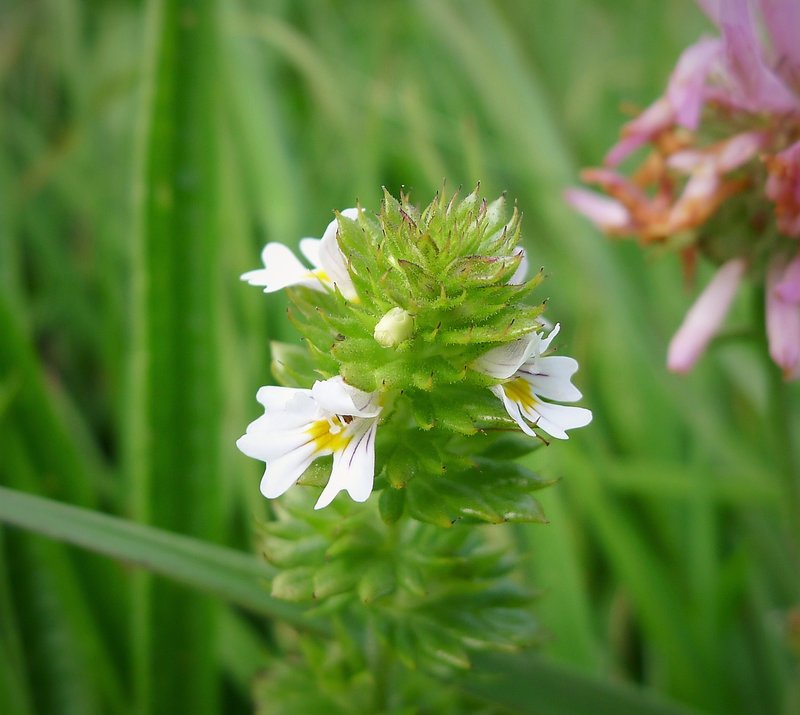
Danny Steven S.,Anne Burgess (www.geograph.org.uk),Mike Pennington (www.geograph.org.uk),Amédée Masclef (en.wikipedia.org),Uoaei1,Uoaei1,Rosser1954,Lazaregagnidze,Rosser1954,Uoaei1,Uoaei1,Uoaei1,Uoaei1,Uoaei1,Uoaei1,Uoaei1,Uoaei1,Uoaei1,Stephan Sprinz,Kostka Martin,Enrico Blasutto,Цветана Цукерман

Taxonomy
- Division:
- Magnoliophyta | - Flowering plants
- Family:
- Orobanchaceae
- Genus:
- Euphrasia
- Species:
- Euphrasia officinalis
- USDA Symbol:
- EUOF2
Growth Characteristics
- Height:
- 30 cm
- Light Requirements:
- Full Sun
- Drought Tolerance:
- Low
- Bloom Months:
- jun,jul,aug,sep
- Bloom Colors:
- white, purple
Garden & Ecology Notes
- Wildlife Value:
- bees
Soil Requirements
- Soil Type:
- poor, sandy, well-drained soil
- pH:
- 5.5 - 7.5 (slightly acidic to neutral)
- Drainage:
- excellent drainage required
- Moisture:
- dry to moderate
- Notes:
- often found in grasslands and heathlands