
Cypress Panicgrass
Dichanthelium dichotomum
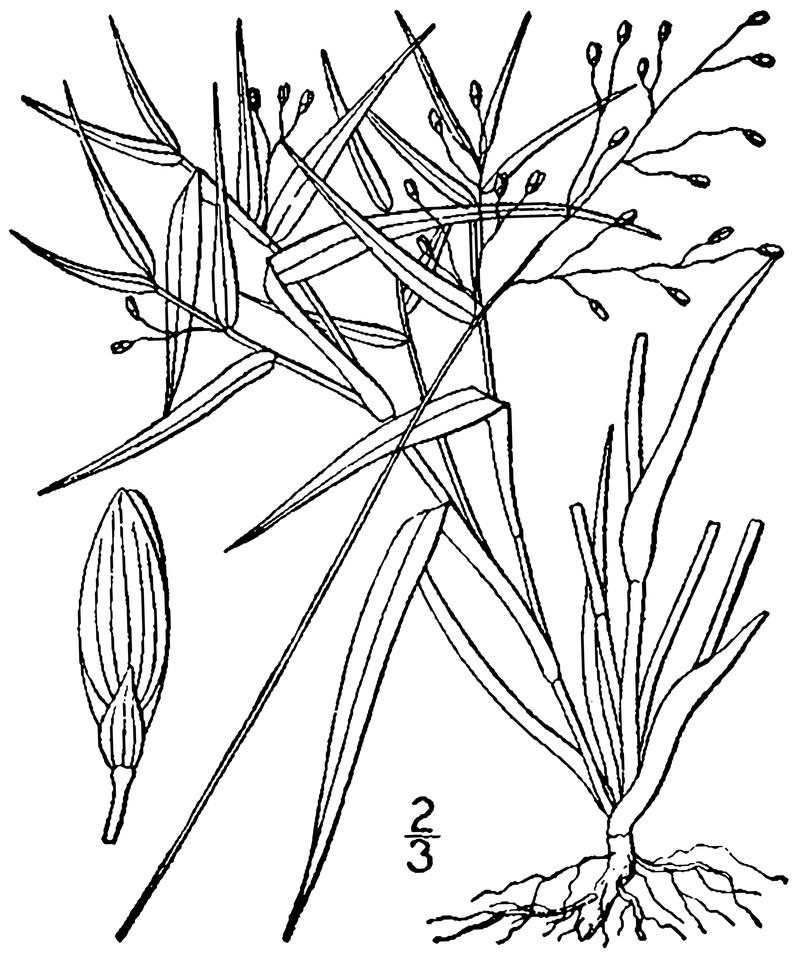
Britton, N.L., and A. Brown. 1913. An illustrated flora of the northern United States, Canada and the British Possessions. 3 vols. Charles Scribner's Sons, New York. Vol. 1: 149. Courtesy of Kentucky Native Plant Society. Scanned by Omnitek Inc.
Taxonomy
- Division:
- Magnoliophyta | - Flowering plants
- Family:
- Poaceae
- Genus:
- Dichanthelium
- Species:
- Dichanthelium dichotomum
Growth Characteristics
- Life Cycle:
- Perennial
- Growth Habit:
- Graminoid
- Height:
- 3-4 ft
- Light Requirements:
- Full Sun
- Drought Tolerance:
- Low
- Bloom Months:
- apr, may, jun, aug, sep, oct, nov
- Bloom Colors:
- Not Applicable
Native Range
United States: Alabama, Arkansas, Connecticut, District of Columbia, Delaware, Florida, Georgia, Iowa, Illinois, Indiana, Kentucky, Louisiana, Massachusetts, Maryland, Maine, Michigan, Minnesota, Missouri, Mississippi, North Carolina, New Hampshire, New Jersey, New York, Ohio, Oklahoma, Pennsylvania, Puerto Rico, Rhode Island, South Carolina, Tennessee, Texas, Virginia, Vermont, Wisconsin, West Virginia, Canada: New Brunswick, Ontario
Host Plant for Caterpillars
Soil Requirements
- Soil Type:
- moist, sandy or loamy soil
- pH:
- 4.5 - 6.5 (acidic to slightly acidic)
- Drainage:
- tolerates poor drainage
- Moisture:
- consistently moist
- Notes:
- commonly found in wetland areas and forest edges
Germination Information
Pre-treatment: De-tufted seed is planted into round cell greenhouse flat liners with 38 cells per flat that have been filled with coarse processed bark and composted pine bark growing medium. Seed is surface sown at a rate of 3-5 seeds per cell and lightly covered with starter sized, 1/16" - 1/8" diameter, granite poultry grit to combat damping off diseases. Prepared flats are lightly hand watered to slightly moisten the growing medium.
Source: npn.rngr.net