
Island Redberry
Rhamnus crocea subsp. pirifolia
- Native to:
- Mexican Pacific Is., United States
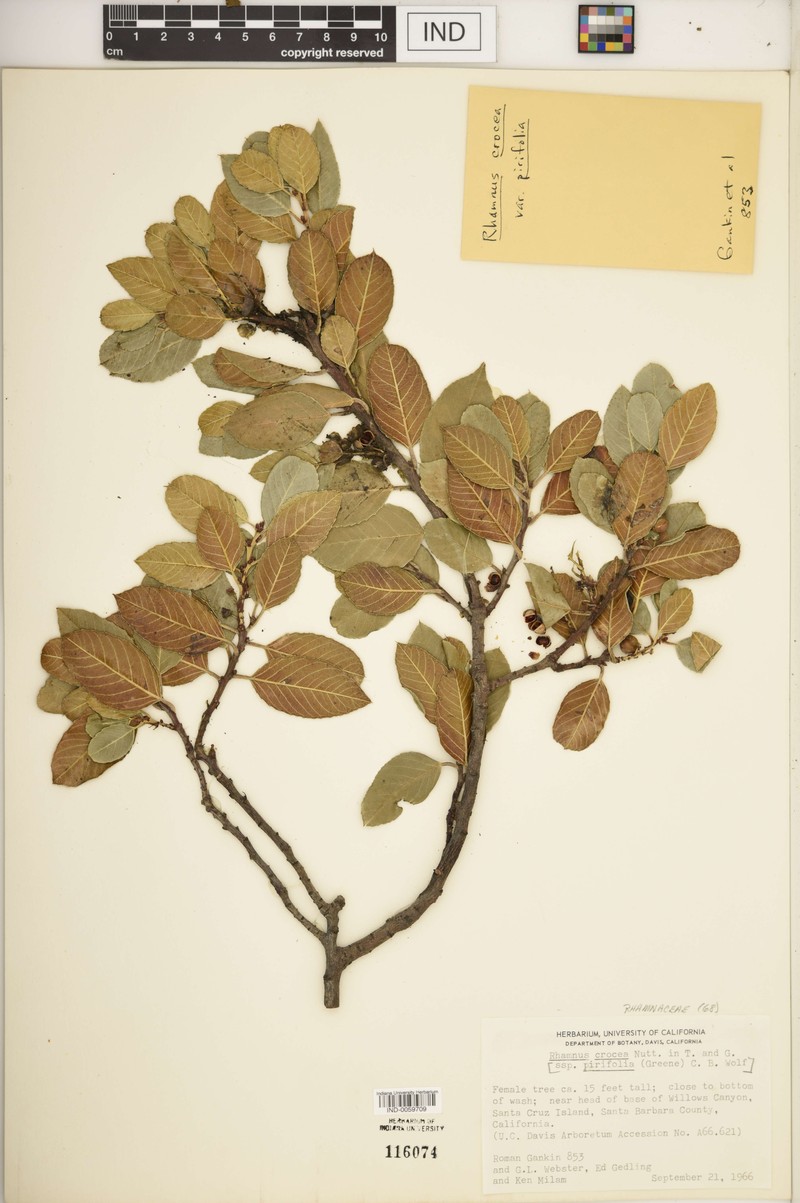
GBIF: Roman Gankin; G. L. Webster, Ed Gedling & Ken Milam
Taxonomy
- Division:
- Magnoliophyta | - Flowering plants
- Family:
- Rhamnaceae
- Genus:
- Rhamnus
- Species:
- Rhamnus crocea subsp. pirifolia
- USDA Symbol:
- RHPI
Growth Characteristics
- Life Cycle:
- Perennial
- Growth Habit:
- Shrub , Tree
- Height:
- 250 cm
- Light Requirements:
- Full Sun
- Drought Tolerance:
- High
- Bloom Months:
- mar,apr,may
- Bloom Colors:
- yellow, green
- Landscaping Shrub:
- Yes
Host Plant for Caterpillars
Ceanothus Silkmoth (Hyalophora euryalus), Itame guenearia, Nola minna, Nola nr. minna, Pero macdunnoughi, Spilosoma vestalis, Stigmella sp. D, Triphosa californiata, Hermelycaena hermes, Pale Swallowtail (Papilio eurymedon), Western Tiger Swallowtail (Papilio rutulus)
Garden & Ecology Notes
- Wildlife Value:
- birds, small mammals
- Deer Resistant:
- Yes
- Fire Ecology:
- Fire adapted — tolerates or benefits from fire
- Fire Notes:
- Resprouts vigorously from the root crown following fire; common component of chaparral communities.
Soil Requirements
- Soil Type:
- well-drained, sandy or rocky soil
- pH:
- 6.0 - 7.5 (slightly acidic to neutral)
- Drainage:
- excellent drainage required
- Moisture:
- dry to moderate
- Notes:
- native to chaparral and coastal sage scrub
Propagation & Germination
- Stratification:
- Cold/moist stratification required — 60–90 days
- Germination Time:
- 30–90 days
- Notes:
- Seeds may have erratic germination; cold stratification improves germination rates.
Pre-treatment: Seeds are surface sterilized with a 5 to 10 minute Physan disinfectant soak or a 3 to 5 minute 5% bleach solution. Seeds are then placed into cold, moist stratification for 1 to 2 months at 40 F or sown in late October for natural stratification.
Establishment: Seeds are hand collected when fully matured, typically in August and September. The plant is endemic to the Channel islands.
Source: npn.rngr.net