
Spirea
Spiraea vanhouttei
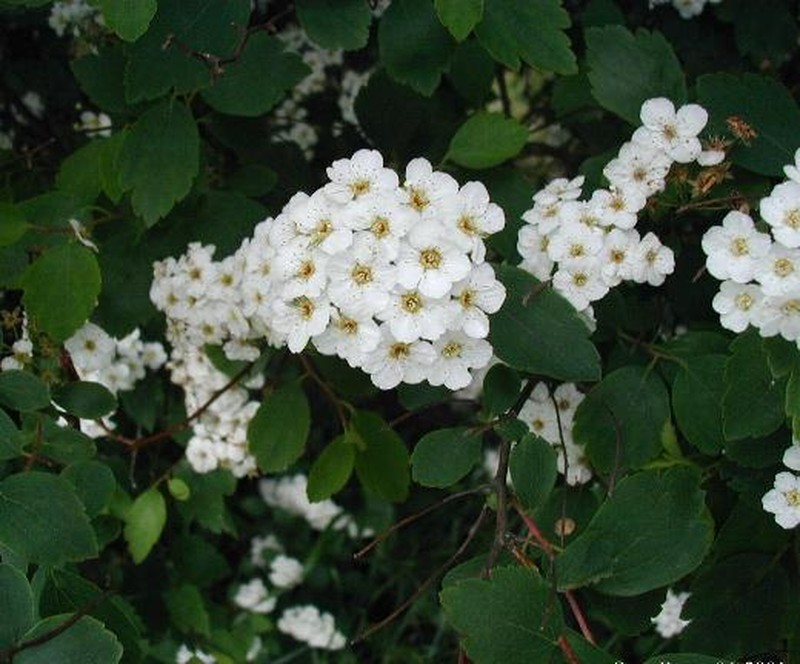
Taxonomy
- Division:
- Magnoliophyta | - Flowering plants
- Family:
- Rosaceae
- Genus:
- Spiraea
- Species:
- Spiraea vanhouttei
Growth Characteristics
- Life Cycle:
- Perennial
- Growth Habit:
- Shrub
- Height:
- 6-8 ft
- Light Requirements:
- Full Sun
- Drought Tolerance:
- High
- Bloom Months:
- mar, apr, may, jun, jul, aug
- Bloom Colors:
- white
- Landscaping Shrub:
- Yes
Native Range
United States: Arkansas, Connecticut, Illinois, Kentucky, Louisiana, Massachusetts, Maryland, Michigan, Minnesota, Missouri, North Carolina, New York, Ohio, Pennsylvania, Utah, West Virginia, Canada: Nova Scotia, Ontario
Keystone Species Ranking
- Caterpillar Keystone:
- ★★☆☆☆ Based on number of butterfly and moth species using this genus as host plant (Source: National Wildlife Federation)
Reported Fauna Sightings
Bees: American bumble bee (Bombus pensylvanicus), American bumble bee (Bombus pensylvanicus), Black and gold bumble bee (Bombus auricomus), Black and gold bumble bee (Bombus auricomus), Black-tailed bumble bee (Bombus melanopygus), Black-tailed bumble bee (Bombus melanopygus), Bombus borealis (Bombus borealis), Bombus borealis (Bombus borealis), Brown-belted bumble bee (Bombus griseocollis), Brown-belted bumble bee (Bombus griseocollis), bumblebee (Bombus Latreille), bumblebee (Bombus Latreille), Central bumble bee (Bombus centralis), Central bumble bee (Bombus centralis), Common eastern bumble bee (Bombus impatiens), Common eastern bumble bee (Bombus impatiens), Confusing bumble bee (Bombus perplexus), Confusing bumble bee (Bombus perplexus), Cryptic bumble bee (Bombus cryptarum), Cryptic bumble bee (Bombus cryptarum), Fernald cuckoo bumble bee (Bombus flavidus), Fernald cuckoo bumble bee (Bombus flavidus), Forest bumble bee (Bombus sylvicola), Forest bumble bee (Bombus sylvicola), Fuzzy-horned bumble bee (Bombus mixtus), Fuzzy-horned bumble bee (Bombus mixtus), Half-black bumble bee (Bombus vagans), Half-black bumble bee (Bombus vagans), Hunt's bumble bee (Bombus huntii), Hunt's bumble bee (Bombus huntii), Lemon cuckoo bumble bee (Bombus citrinus), Lemon cuckoo bumble bee (Bombus citrinus), Morrison bumble bee (Bombus morrisoni), Morrison bumble bee (Bombus morrisoni), Nevada bumble bee (Bombus nevadensis), Nevada bumble bee (Bombus nevadensis), Northern amber bumble bee (Bombus borealis), Northern amber bumble bee (Bombus borealis), Obscure bumble bee (Bombus caliginosus), Obscure bumble bee (Bombus caliginosus), Red-belted bumble bee (Bombus rufocinctus), Red-belted bumble bee (Bombus rufocinctus), 🛑Rusty-patched bumble bee (Bombus affinis), 🛑Rusty-patched bumble bee (Bombus affinis), Sitka bumble bee (Bombus sitkensis), Sitka bumble bee (Bombus sitkensis), Southern plains bumble bee (Bombus fraternus), Southern plains bumble bee (Bombus fraternus), Tri-colored bumble bee (Bombus ternarius), Tri-colored bumble bee (Bombus ternarius), Two-form bumble bee (Bombus bifarius), Two-form bumble bee (Bombus bifarius), Two-spotted bumble bee (Bombus bimaculatus), Two-spotted bumble bee (Bombus bimaculatus), van Dyke bumble bee (Bombus vandykei), van Dyke bumble bee (Bombus vandykei), Western bumble bee (Bombus occidentalis), Western bumble bee (Bombus occidentalis), White-shouldered bumble bee (Bombus appositus), White-shouldered bumble bee (Bombus appositus), Yellow bumble bee (Bombus fervidus), Yellow bumble bee (Bombus fervidus), Yellow head bumble bee (Bombus flavifrons), Yellow head bumble bee (Bombus flavifrons), Yellow-banded bumble bee (Bombus terricola), Yellow-banded bumble bee (Bombus terricola), Yellow-faced bumble bee (Bombus vosnesenskii), Yellow-faced bumble bee (Bombus vosnesenskii) Butterflies:American Copper (Lycaena hypophlaeas), Clouded Sulphur (Colias philodice), Clouded Sulphur (Colias philodice), Common Ringlet (North America) (Coenonympha california), Common Ringlet (North America) (Coenonympha california), Common Wood-Nymph (Cercyonis pegala), Common Wood-Nymph (Cercyonis pegala), Crescents (Phyciodes Hübner), Dun Skipper (Euphyes vestris), Dun Skipper (Euphyes vestris), Eastern Comma (Polygonia comma), Eastern Comma (Polygonia comma), Eastern Comma (Polygonia comma), Eastern Tailed-Blue (Cupido comyntas), Eastern Tailed-Blue (Cupido comyntas), Eastern Tiger Swallowtail (Pterourus glaucus), Eastern Tiger Swallowtail (Pterourus glaucus), (Thymelicus lineola), (Thymelicus lineola), Eyed Brown (Satyrodes eurydice), Eyed Brown (Satyrodes eurydice), Grass Skippers (Monza Evans), Great Spangled Fritillary (Argynnis cybele), Great Spangled Fritillary (Argynnis cybele), Harris's Checkerspot (Chlosyne harrisii), Harris's Checkerspot (Chlosyne harrisii), Large Heath (Coenonympha tullia), Least Skipper (Ancyloxypha numitor), Least Skipper (Ancyloxypha numitor), Little Wood Satyr (Megisto cymela), Little Wood Satyr (Megisto cymela), Long Dash Skipper (Limochores Scudder), Milbert's Tortoiseshell (Aglais milberti), Milbert's Tortoiseshell (Aglais milberti), Northern Crescent (Phyciodes cocyta), Northern Crescent (Phyciodes cocyta), Northern Pearly-eye (Lethe anthedon), Northern Pearly-eye (Lethe anthedon), Orange Sulphur (Colias eurytheme), Orange Sulphur (Colias eurytheme), Pearl Crescent (Phyciodes tharos), Pearl Crescent (Phyciodes tharos), Peck's Skipper (Polites coras), Red-spotted Purple (Limenitis arthemis), Red-spotted Purple (Limenitis arthemis), Silver-spotted Skipper (Epargyreus clarus), Silver-spotted Skipper (Epargyreus clarus), Tawny-edged Skipper (Polites themistocles), Tawny-edged Skipper (Polites themistocles), Tiger Swallowtails and Allies (Pterourus Scopoli)
Soil Requirements
- Soil Type:
- rich, well-drained loamy soil
- pH:
- 6.0 - 7.5 (slightly acidic to neutral)
- Drainage:
- excellent drainage required
- Moisture:
- dry to moderate
- Notes:
- prefers sunny locations with good air circulation