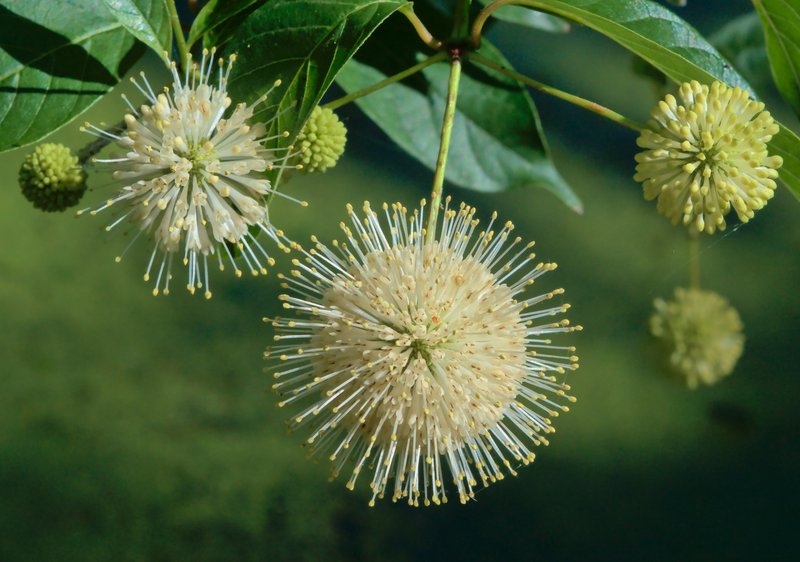
Taxonomy
- Division:
- Magnoliophyta | - Flowering plants
- Family:
- Rubiaceae
- Genus:
- Cephalanthus
- Species:
- Cephalanthus occidentalis
Growth Characteristics
- Life Cycle:
- Perennial
- Growth Habit:
- Shrub , Tree
- Height:
- 12-20 ft
- Light Requirements:
- Part Shade, Shade
- Drought Tolerance:
- High
- Bloom Months:
- jun, jul, aug, sep
- Bloom Colors:
- White, Pink
- Landscaping Shrub:
- Yes
Native Range
United States: Alabama, Arkansas, Arizona, California, Connecticut, District of Columbia, Delaware, Florida, Georgia, Iowa, Illinois, Indiana, Kansas, Kentucky, Louisiana, Massachusetts, Maryland, Maine, Michigan, Minnesota, Missouri, Mississippi, North Carolina, Nebraska, New Hampshire, New Jersey, New York, Ohio, Oklahoma, Pennsylvania, Rhode Island, South Carolina, Tennessee, Texas, Virginia, Vermont, Wisconsin, West Virginia, Canada: New Brunswick, Nova Scotia, Ontario, Prince Edward Island, Quebec
Keystone Species Ranking
- Caterpillar Keystone:
- ★★★☆☆
Based on number of butterfly and moth species using this genus as host plant (Source: National Wildlife Federation)
Host Plant for Caterpillars
Aethes cephalanthana, Beautiful Wood Nymph (Eudryas grata), buttoned snout moth (Ledaea perditalis), Ceanothus Silkmoth (Hyalophora euryalus), Cecropia moth (Hyalophora cecropia), connubial underwing (Catocala connubialis), Fall webworm (Hyphantria cunea), Harrisimemna trisignata, Hydrangea sphinx (Darapsa versicolor), Lebeau's silk moth (Rothschildia lebeau), Melanomma auricinctaria, Mompha cephalonthiella, Promethea silkmoth (Callosamia promethea), Regal Moth (Citheronia regalis), Smeared Dagger Moth (Acronicta oblinita), tentoriferella (Machimia tentoriferella), Titan sphinx (Aellopos titan), White-marked Tussock Moth (Orgyia leucostigma)
Reported Fauna Sightings
Bees: American bumble bee (Bombus pensylvanicus), American bumble bee (Bombus pensylvanicus), Black-tailed bumble bee (Bombus melanopygus), Black-tailed bumble bee (Bombus melanopygus), Bombus borealis (Bombus borealis), Bombus borealis (Bombus borealis), Bombus vagans (Bombus vagans), Bombus vagans (Bombus vagans), Brown-belted bumble bee (Bombus griseocollis), Brown-belted bumble bee (Bombus griseocollis), bumblebee (Bombus Latreille), bumblebee (Bombus Latreille), Common eastern bumble bee (Bombus impatiens), Common eastern bumble bee (Bombus impatiens), Confusing bumble bee (Bombus perplexus), Confusing bumble bee (Bombus perplexus), Crotch bumble bee (Bombus crotchii), Crotch bumble bee (Bombus crotchii), Southern plains bumble bee (Bombus fraternus), Southern plains bumble bee (Bombus fraternus), Two-spotted bumble bee (Bombus bimaculatus), Two-spotted bumble bee (Bombus bimaculatus), Yellow-faced bumble bee (Bombus vosnesenskii), Yellow-faced bumble bee (Bombus vosnesenskii) Butterflies:Carolina Satyr (Hermeuptychia sosybius), Carolina Satyr (Hermeuptychia sosybius), Clouded Sulphur (Colias philodice), Clouded Sulphur (Colias philodice), Cloudywing sp. (Thorybes Scudder), Fiery Skipper (Hylephila phyleus), Fiery Skipper (Hylephila phyleus), Little Yellow (Pyrisitia lisa), Little Yellow (Pyrisitia lisa), Pipevine Swallowtail (Battus philenor), Pipevine Swallowtail (Battus philenor), Red Admiral (Vanessa atalanta), Red-Spotted Purple (astyanax) (Limenitis arthemis), Red-Spotted Purple (astyanax) (Limenitis arthemis), Silver-spotted Skipper (Epargyreus clarus), Silver-spotted Skipper (Epargyreus clarus), Spicebush Swallowtail (Pterourus troilus), Tawny-edged Skipper (Polites themistocles), Tawny-edged Skipper (Polites themistocles)
Soil Requirements
- Soil Type:
- rich, moisture-retentive loamy soil
- pH:
- 5.5 - 7.5 (slightly acidic to neutral)
- Drainage:
- tolerates poor drainage
- Moisture:
- consistently moist
- Notes:
- Commonly found in wetlands and along water bodies
Germination Information
Pre-treatment: Cuttings were cut to 4 to 6" lengths with at least 2 nodes, having an angled cut on the bottom and a straight cut on the top and leaves were trimmed to approximately 50%. The bottom of the cuttings were dipped in Hormodin 1 (0.1% IBA) powder and stuck in 2" cells filled with high porosity peat-based medium.
Establishment: Cuttings are preferred for higher germination rates. Seeds can also be used for propagation, but no germination rates are given for seeds. No temperature information is provided in the protocols. The protocols also suggest that no pre-treatment is required for fresh seeds.
Source: npn.rngr.net