
Peachleaf Willow
Salix amygdaloides
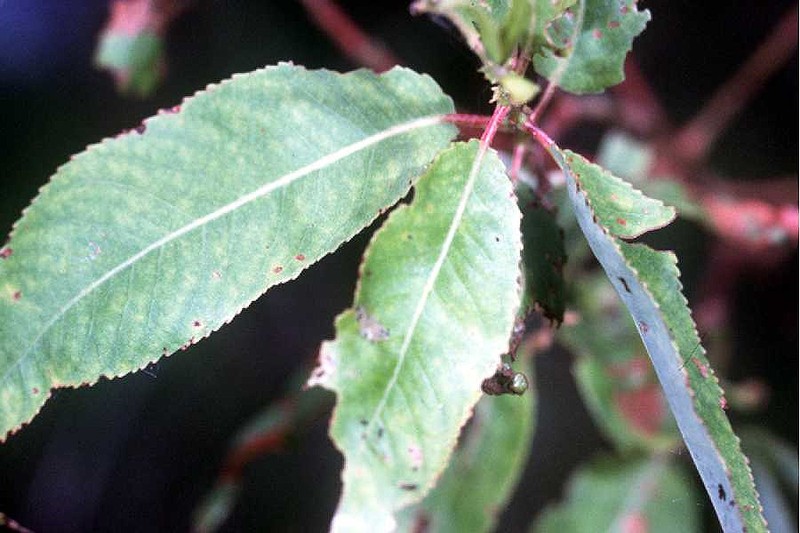
Taxonomy
- Division:
- Magnoliophyta | - Flowering plants
- Family:
- Salicaceae
- Genus:
- Salix
- Species:
- Salix amygdaloides
Growth Characteristics
- Life Cycle:
- Perennial
- Growth Habit:
- Shrub , Tree
- Height:
- More than 40 ft
- Light Requirements:
- Full Sun, Part Shade, Shade
- Drought Tolerance:
- High
- Bloom Months:
- apr, may, jun
- Bloom Colors:
- Yellow, Green
Native Range
United States: Arizona, Colorado, Iowa, Idaho, Illinois, Indiana, Kansas, Kentucky, Michigan, Minnesota, Missouri, Montana, North Dakota, Nebraska, New Mexico, Nevada, New York, Ohio, Oklahoma, Oregon, Pennsylvania, South Dakota, Texas, Utah, Washington, Wisconsin, Wyoming, Canada: Alberta, British Columbia, Manitoba, Ontario, Quebec, Saskatchewan
Keystone Species Ranking
- Caterpillar Keystone:
- ★☆☆☆☆ Based on number of butterfly and moth species using this genus as host plant (Source: National Wildlife Federation)
- Bee Keystone:
- ★☆☆☆☆ Based on number of native bee species using this genus for pollen and nectar (Source: National Wildlife Federation)
Host Plant for Caterpillars
Soil Requirements
- Soil Type:
- rich, moist, well-drained loamy soil
- pH:
- 5.5 - 7.5 (slightly acidic to neutral)
- Drainage:
- tolerates poor drainage
- Moisture:
- consistently moist
- Notes:
- Commonly found in floodplains and along riverbanks
Germination Information
Pre-treatment: Cuttings are stuck to a depth of 10 cm in a 2:1:1 peat:perlite:vermiculite mixture. A controlled release fertilizer 14-14-14 is incorporated into the media at the rate of 4 kg/m3. Cuttings are watered in and kept moist throughout the rooting period using an intermittent misting schedule.
Establishment: Cuttings are collected from stooling beds that are hedged to maintain juvenile wood that is straight and for ease of handling and sticking in field beds. Wild collections are also grown at the nursery and kept separated according to source. For greenhouse propagation, cuttings are taken from dormant plants growing in stooling blocks in March (or anytime January to early April). The earlier the cuttings are taken, the longer they can be stored before bud burst occurs during storage. Once bud burst occurs, rooting success drops quickly.
Source: npn.rngr.net