
Narrowleaf Willow
Salix exigua
- Native to:
- Canada, Mexico, United States
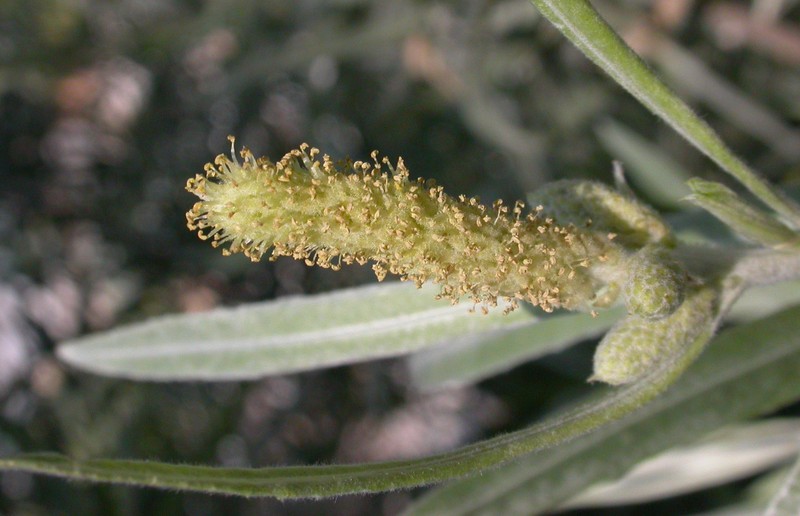
No machine-readable author provided. Curtis Clark assumed (based on copyright claims).
Taxonomy
- Division:
- Magnoliophyta | - Flowering plants
- Family:
- Salicaceae
- Genus:
- Salix
- Species:
- Salix exigua
- USDA Symbol:
- SAEX
Growth Characteristics
- Life Cycle:
- Perennial
- Growth Habit:
- Shrub , Tree
- Height:
- 900 cm
- Light Requirements:
- Full Sun,Part Shade
- Drought Tolerance:
- Low
- Bloom Months:
- mar,apr,may
- Bloom Colors:
- yellow, green
Wildlife Benefits
- Bees:
- ★★★★★ Documented bee visitation (GBIF)
- Butterflies & Moths:
- ★★★★☆ Documented Lepidoptera association (GBIF)
- Caterpillars:
- ★★★☆☆ Recorded caterpillar host plant (HOSTS Database)
Keystone Species Ranking
- Caterpillar Keystone:
- ★★★★★ Butterfly & moth species supported by this genus (NWF)
- Pollen Specialist Bee Keystone:
- ★★★★★ Native pollen specialist bee species supported by this genus (NWF)
Host Plant for Caterpillars
Reported Fauna Sightings
Garden & Ecology Notes
- Wildlife Value:
- birds, butterflies, small mammals
- Fire Ecology:
- Fire adapted — tolerates or benefits from fire
- Fire Notes:
- Resprouts vigorously from roots after fire; often colonizes burned or disturbed riparian areas.
Soil Requirements
- Soil Type:
- sandy, nutrient-poor, well-drained
- pH:
- 5.5 - 8.0 (slightly acidic to neutral)
- Drainage:
- tolerates poor drainage
- Moisture:
- consistently moist
- Notes:
- Commonly found along riverbanks and floodplains
Propagation & Germination
- Stratification:
- Cold/moist stratification required — 30–60 days
- Germination Time:
- 14–30 days
- Notes:
- Seeds are short-lived and should be sown fresh; no pretreatment needed if sown immediately.
Pre-treatment: For seeds, no stratification is required and they should be sown immediately. For cuttings, they should be 20 cm in length and 7 mm in caliper, with the base recut and 1/3 of leaves or buds removed. Cuttings should be placed in a 2 minute fungicide bath to remove surface pathogens and treated with 1000 ppm liquid IBA.
Establishment: Salix exigua is easily produced by either softwood or hardwood cuttings. Salix has latent preformed root initials present in the stems. The most critical factor in the collection of viable Salix seed is frequent observation of catkin development. For this reason, establishment of stock plants in the nursery provides significant advantages over wild-land collections.
Source: npn.rngr.net