
Scouler's Willow
Salix scouleriana
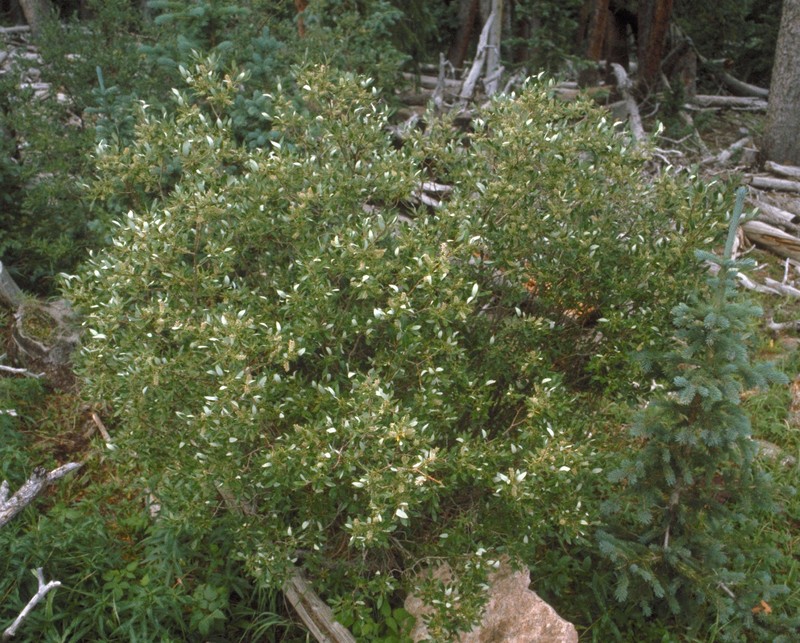
Dave Powell, USDA Forest Service, United States
Taxonomy
- Division:
- Magnoliophyta | - Flowering plants
- Family:
- Salicaceae
- Genus:
- Salix
- Species:
- Salix scouleriana
Growth Characteristics
- Life Cycle:
- Perennial
- Growth Habit:
- Shrub , Tree
- Height:
- More than 40 ft
- Light Requirements:
- Full Sun, Part Shade, Shade
- Drought Tolerance:
- High
- Bloom Months:
- feb, mar, apr, may, jun
- Bloom Colors:
- Yellow
Native Range
United States: Alaska, Arizona, California, Colorado, Idaho, Montana, New Mexico, Nevada, Oregon, South Dakota, Utah, Washington, Wyoming, Canada: Alberta, British Columbia, Northwest Territories, Saskatchewan, Yukon
Keystone Species Ranking
- Caterpillar Keystone:
- ★☆☆☆☆ Based on number of butterfly and moth species using this genus as host plant (Source: National Wildlife Federation)
- Bee Keystone:
- ★☆☆☆☆ Based on number of native bee species using this genus for pollen and nectar (Source: National Wildlife Federation)
Host Plant for Caterpillars
Soil Requirements
- Soil Type:
- moist, well-drained, loamy or sandy soil
- pH:
- 5.5 - 7.5 (slightly acidic to neutral)
- Drainage:
- tolerates poor drainage
- Moisture:
- consistently moist
- Notes:
- Common in riparian zones and wetland edges
Germination Information
Pre-treatment: No stratification required for seeds. For cuttings, 94% rooting was obtained without the use of IBA. However, 84% to 100% rooting was obtained in both hardwood and softwood cuttings treated with 1000, 2000, and 3000 ppm IBA.
Establishment: S. scouleriana is found from Alaska, Yukon and Northwest Territories south to South Dakota, New Mexico, Arizona and California. It grows from the lowlands and foothills to mid-montane elevations. For cuttings, softwood stem tip cuttings root more quickly than hardwood cuttings. For seeds, the germination medium used is a standard sphagnum peat moss and perlite mix of fairly coarse texture (Sunshine #1).
Source: npn.rngr.net