
California Buckeye
Aesculus californica
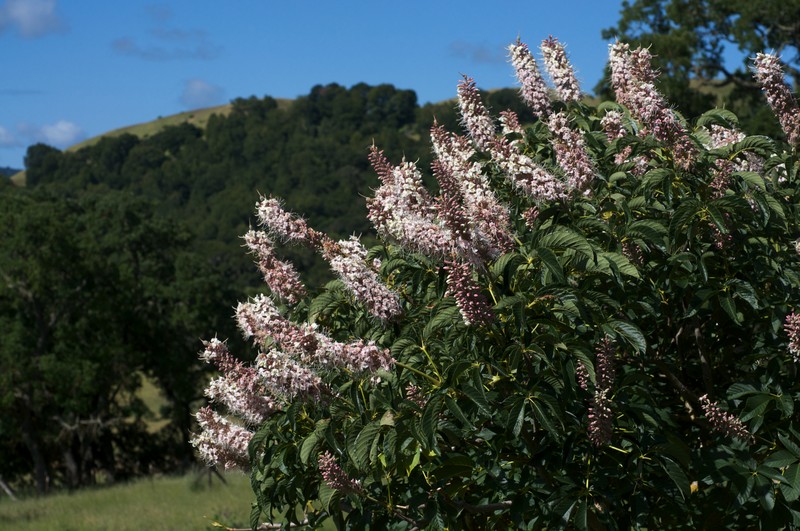
Taxonomy
- Division:
- Magnoliophyta | - Flowering plants
- Family:
- Sapindaceae
- Genus:
- Aesculus
- Species:
- Aesculus californica
Growth Characteristics
- Life Cycle:
- Perennial
- Growth Habit:
- Shrub , Tree
- Height:
- 20-40 ft
- Light Requirements:
- Full Sun, Part Shade
- Drought Tolerance:
- Medium
- Bloom Months:
- apr, may, jun
- Bloom Colors:
- White, Pink
Native Range
United States: California, Oregon
Host Plant for Caterpillars
Archips rileyana, fruit-tree leafroller (Archips argyrospila), Obliquebanded leafroller (Choristoneura rosaceana), orange tortrix moth (Argyrotaenia franciscana), Orthosia pacifica, Sabulodes caberata, Holly Blue (Celastrina argiolus)
Reported Fauna Sightings
Bees: Yellow-faced bumble bee (Bombus vosnesenskii), Yellow-faced bumble bee (Bombus vosnesenskii)
Soil Requirements
- Soil Type:
- well-drained, rocky or sandy loam
- pH:
- 5.5 - 7.5 (slightly acidic to neutral)
- Drainage:
- excellent drainage required
- Moisture:
- dry to moderate
- Notes:
- native to dry slopes and foothills
Germination Information
Pre-treatment: Seeds are soaked in water for 24 hours, then placed in a 5% bleach solution for 1 minute. After rinsing well, seeds are placed in sterile perlite in a plastic freezer bag and kept in a refrigerator for 6 to 8 weeks. Seeds are sown as radicle emerges.
Establishment: Seeds are collected between September 1st and December 1st. The plant is found in dry slopes and canyons below 4000 ft in the Coast ranges and Sierra Nevada from Siskiyou and Shasta counties south to Los Angeles and Kern counties, California.
Source: npn.rngr.net