
Climbing Nightshade
Solanum dulcamara
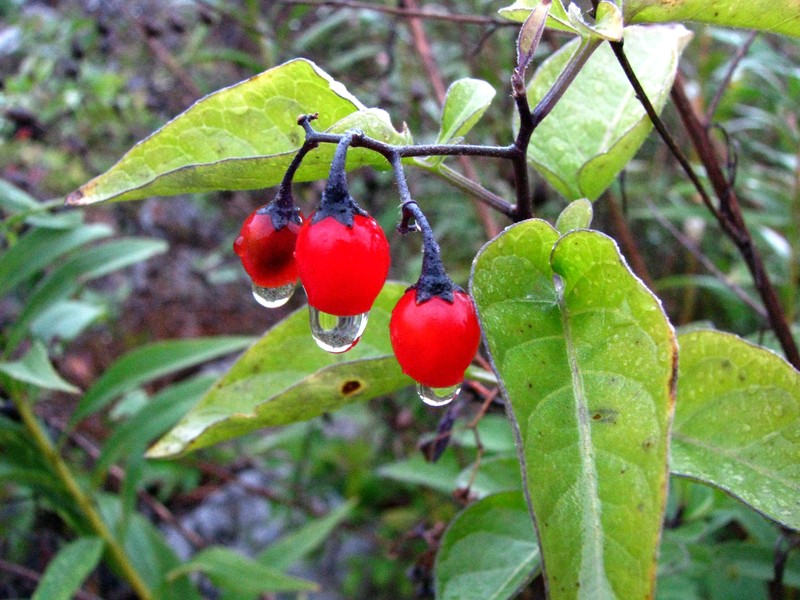
David Eickhoff from Pearl City, Hawaii, USA
Taxonomy
- Division:
- Magnoliophyta | - Flowering plants
- Family:
- Solanaceae
- Genus:
- Solanum
- Species:
- Solanum dulcamara
Growth Characteristics
- Life Cycle:
- Perennial
- Growth Habit:
- Forb/herb , Subshrub , Vine
- Height:
- 6-8 ft
- Light Requirements:
- Full Sun
- Drought Tolerance:
- Low
- Bloom Months:
- may, sep
- Bloom Colors:
- purple, red, yellow
Native Range
United States: California, Colorado, Connecticut, District of Columbia, Delaware, Florida, Georgia, Iowa, Idaho, Illinois, Indiana, Kansas, Kentucky, Massachusetts, Maryland, Maine, Michigan, Minnesota, Missouri, Montana, North Carolina, North Dakota, Nebraska, New Hampshire, New Jersey, New Mexico, Nevada, New York, Ohio, Oklahoma, Oregon, Pennsylvania, Rhode Island, South Dakota, Tennessee, Utah, Virginia, Vermont, Washington, Wisconsin, West Virginia, Wyoming, Canada: British Columbia, New Brunswick, Nova Scotia, Ontario, Prince Edward Island, Quebec, Saskatchewan
Host Plant for Caterpillars
Ailanthus silkmoth (Samia cynthia), eggplant leafroller moth (Lineodes integra), Fall armyworm (Spodoptera frugiperda), Potato tuber moth (Phthorimaea operculella), tobacco hornworm (Manduca sexta), Walker’s Atlas Moth (Samia walkeri)
Reported Fauna Sightings
Bees: Brown-belted bumble bee (Bombus griseocollis), Brown-belted bumble bee (Bombus griseocollis), Common eastern bumble bee (Bombus impatiens), Common eastern bumble bee (Bombus impatiens), Half-black bumble bee (Bombus vagans), Half-black bumble bee (Bombus vagans), Hunt's bumble bee (Bombus huntii), Hunt's bumble bee (Bombus huntii), Two-spotted bumble bee (Bombus bimaculatus), Two-spotted bumble bee (Bombus bimaculatus), Yellow-faced bumble bee (Bombus vosnesenskii), Yellow-faced bumble bee (Bombus vosnesenskii)
Soil Requirements
- Soil Type:
- moist, rich, well-drained loamy soil
- pH:
- 5.5 - 7.5 (slightly acidic to neutral)
- Drainage:
- tolerates poor drainage
- Moisture:
- consistently moist
- Notes:
- commonly found in wetlands and riverbanks