
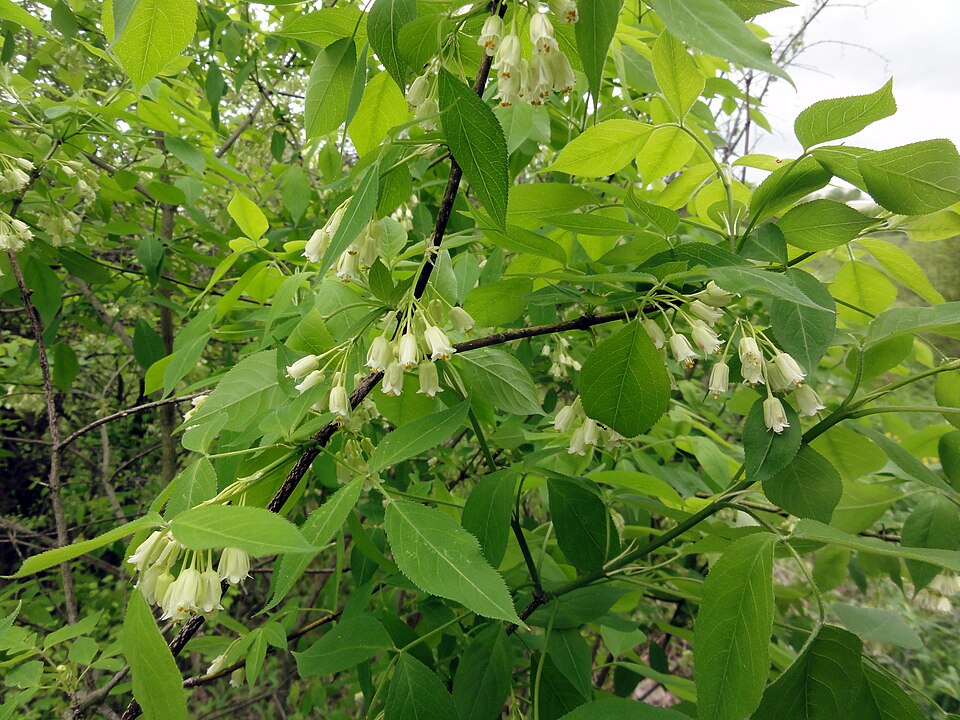
American Bladdernut
Staphylea trifolia
Taxonomy
- Division:
- Magnoliophyta | - Flowering plants
- Family:
- Staphyleaceae
- Genus:
- Staphylea
- Species:
- Staphylea trifolia
Growth Characteristics
- Life Cycle:
- Perennial
- Growth Habit:
- Shrub , Tree
- Height:
- 12-20 ft
- Light Requirements:
- Shade
- Drought Tolerance:
- Medium
- Bloom Months:
- apr, may, jun
- Bloom Colors:
- White
- Landscaping Shrub:
- Yes
Native Range
United States: Alabama, Arkansas, Connecticut, District of Columbia, Delaware, Florida, Georgia, Iowa, Illinois, Indiana, Kansas, Kentucky, Louisiana, Massachusetts, Maryland, Michigan, Minnesota, Missouri, Mississippi, North Carolina, Nebraska, New Hampshire, New Jersey, New York, Ohio, Oklahoma, Pennsylvania, South Carolina, Tennessee, Virginia, Vermont, Wisconsin, West Virginia, Canada: Ontario, Quebec
Host Plant for Caterpillars
Fall webworm (Hyphantria cunea), White-marked Tussock Moth (Orgyia leucostigma)
Reported Fauna Sightings
Bees: Common eastern bumble bee (Bombus impatiens), Common eastern bumble bee (Bombus impatiens), Lemon cuckoo bumble bee (Bombus citrinus), Lemon cuckoo bumble bee (Bombus citrinus), Two-spotted bumble bee (Bombus bimaculatus), Two-spotted bumble bee (Bombus bimaculatus)
Soil Requirements
- Soil Type:
- rich, well-drained loamy soil
- pH:
- 5.5 - 7.0 (slightly acidic to neutral)
- Drainage:
- tolerates poor drainage
- Moisture:
- consistently moist
- Notes:
- prefers forested areas with organic matter
Germination Information
Pre-treatment: Cold-moist stratification for 30 days at 1–5°C (34–41°F).; then Cold-moist stratification for 60 days.
Source: OpenAI GPT-4o