
Virginia Creeper
Parthenocissus quinquefolia
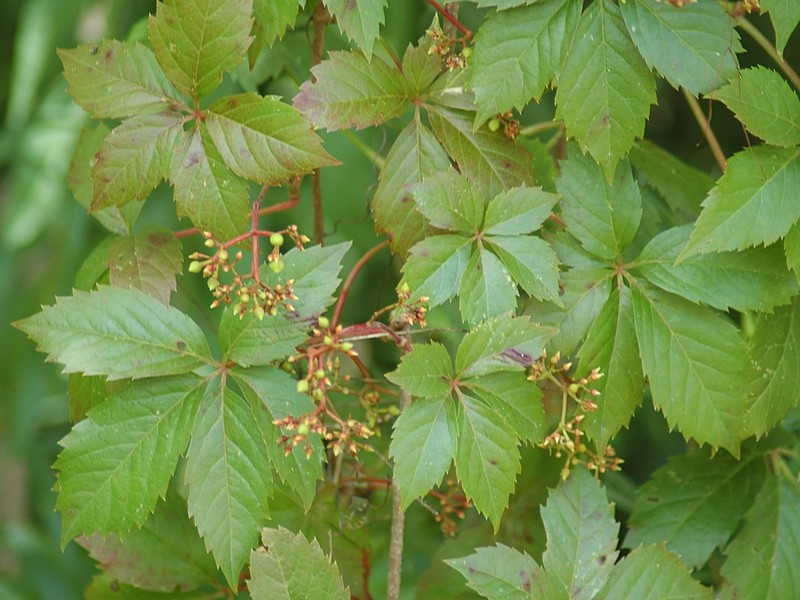
Taxonomy
- Division:
- Magnoliophyta | - Flowering plants
- Family:
- Vitaceae
- Genus:
- Parthenocissus
- Species:
- Parthenocissus quinquefolia
Growth Characteristics
- Life Cycle:
- Perennial
- Growth Habit:
- Vine
- Height:
- 20-40 ft
- Light Requirements:
- Full Sun, Part Shade, Shade
- Drought Tolerance:
- Medium
- Bloom Months:
- may, jun
- Bloom Colors:
- White, Green
Native Range
United States: Alabama, Arkansas, Colorado, Connecticut, District of Columbia, Delaware, Florida, Georgia, Iowa, Illinois, Indiana, Kansas, Kentucky, Louisiana, Massachusetts, Maryland, Maine, Michigan, Minnesota, Missouri, Mississippi, North Carolina, Nebraska, New Hampshire, New Jersey, New York, Ohio, Oklahoma, Pennsylvania, Rhode Island, South Carolina, South Dakota, Tennessee, Texas, Utah, Virginia, Vermont, Wisconsin, West Virginia, Canada: Manitoba, New Brunswick, Nova Scotia, Ontario, Prince Edward Island, Quebec, Saskatchewan
Keystone Species Ranking
- Caterpillar Keystone:
- ★★★☆☆ Based on number of butterfly and moth species using this genus as host plant (Source: National Wildlife Federation)
Host Plant for Caterpillars
Reported Fauna Sightings
Soil Requirements
- Soil Type:
- rich, well-drained loamy soil
- pH:
- 5.5 - 7.5 (slightly acidic to neutral)
- Drainage:
- tolerates poor drainage
- Moisture:
- dry to moderate
- Notes:
- adaptable to various soil types
Germination Information
Pre-treatment: Seeds are cool stratified in mesh bags in moist sand at 40°F, 35% relative humidity for 60 days. Seeds are then drenched with fungicide to prevent mildew.
Establishment: Seeds were collected in Cumberland Gap National Historical Park, George Washington Memorial Parkway, Kentucky. The plant is generally distributed from Maine to Ohio, Iowa, and Nebraska, south to Florida and Texas, and grows in moist soil.
Source: npn.rngr.net