
California Huckleberry
Vaccinium ovatum
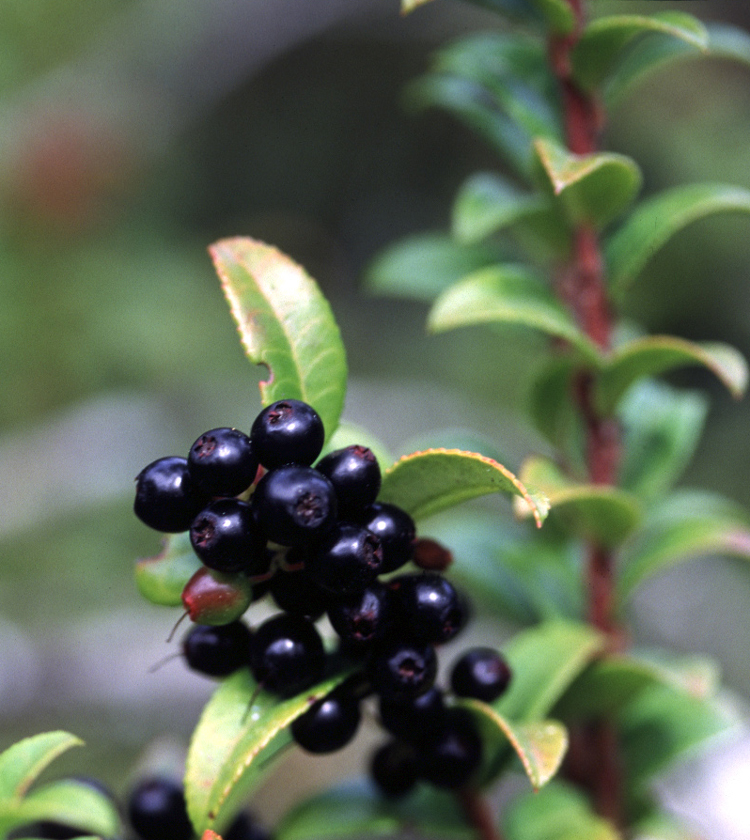
Gordon Leppig & Andrea J. Pickart
Taxonomy
- Division:
- Magnoliophyta | - Flowering plants
- Family:
- Ericaceae
- Genus:
- Vaccinium
- Species:
- Vaccinium ovatum
Growth Characteristics
- Life Cycle:
- Perennial
- Growth Habit:
- Shrub , Subshrub
- Height:
- 8-12 ft
- Light Requirements:
- Full Sun, Part Shade, Shade
- Drought Tolerance:
- Low
- Bloom Months:
- mar, apr, may
- Bloom Colors:
- Pink
- Evergreen Shrub:
- Yes
- Landscaping Shrub:
- Yes
Native Range
United States: California, Oregon, Washington, Canada: British Columbia
Keystone Species Ranking
- Caterpillar Keystone:
- ★☆☆☆☆ Based on number of butterfly and moth species using this genus as host plant (Source: National Wildlife Federation)
- Bee Keystone:
- ★★★★☆ Based on number of native bee species using this genus for pollen and nectar (Source: National Wildlife Federation)
Host Plant for Caterpillars
Adelphagrotis stellaris, Cameraria nemoris, Eucalantica polita, Lotisma trigonana, orange tortrix moth (Argyrotaenia franciscana)
Reported Fauna Sightings
Bees: Black-tailed bumble bee (Bombus melanopygus), Black-tailed bumble bee (Bombus melanopygus), Obscure bumble bee (Bombus caliginosus), Obscure bumble bee (Bombus caliginosus), Sitka bumble bee (Bombus sitkensis), Sitka bumble bee (Bombus sitkensis), Yellow-faced bumble bee (Bombus vosnesenskii), Yellow-faced bumble bee (Bombus vosnesenskii)
Soil Requirements
- Soil Type:
- rich, well-drained loamy soil
- pH:
- 4.5 - 6.0 (acidic)
- Drainage:
- excellent drainage required
- Moisture:
- consistently moist
- Notes:
- Thrives in organic matter-rich environments
Germination Information
Pre-treatment: Seeds are stratified for 60 days in the refrigerator.
Establishment: Seeds are collected between July 1st and November 15th. Mature fruits are dark purple. Seed is yellowish-tan at maturity. V. ovatum is found from British Columbia south to San Diego county, California and Santa Rosa and Santa Cruz islands; mostly below 2,500 feet elevation.
Source: npn.rngr.net