
Scouler's Willow
Salix scouleriana
- Native to:
- Canada, Mexico, United States
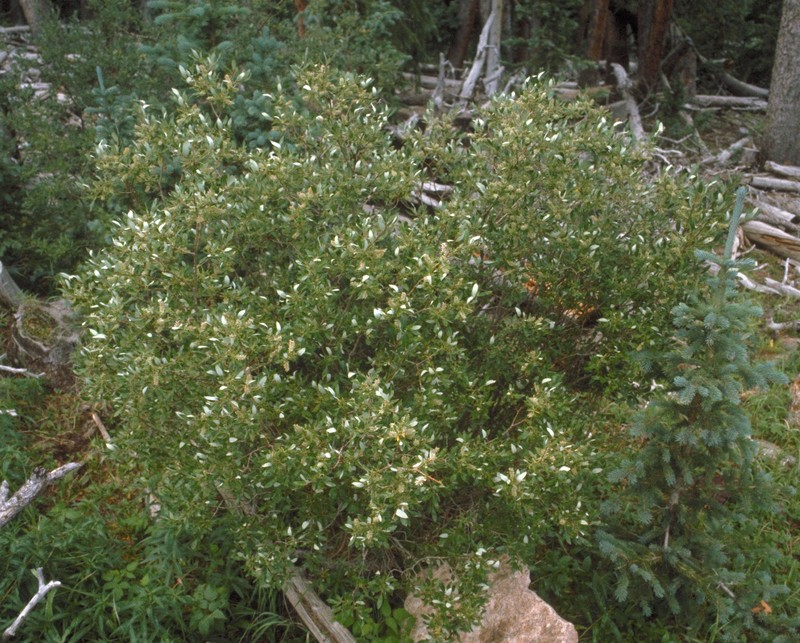
Dave Powell, USDA Forest Service, United States
Taxonomy
- Division:
- Magnoliophyta | - Flowering plants
- Family:
- Salicaceae
- Genus:
- Salix
- Species:
- Salix scouleriana
- USDA Symbol:
- SASC
Growth Characteristics
- Life Cycle:
- Perennial
- Growth Habit:
- Shrub , Tree
- Height:
- 1500 cm
- Light Requirements:
- Full Sun,Part Shade,Shade
- Drought Tolerance:
- Low
- Bloom Months:
- mar,apr,may
- Bloom Colors:
- yellow, green
Wildlife Benefits
- Butterflies & Moths:
- ★☆☆☆☆ Documented Lepidoptera association (GBIF)
- Caterpillars:
- ★★★☆☆ Recorded caterpillar host plant (HOSTS Database)
Keystone Species Ranking
- Caterpillar Keystone:
- ★★★★★ Butterfly & moth species supported by this genus (NWF)
- Pollen Specialist Bee Keystone:
- ★★★★★ Native pollen specialist bee species supported by this genus (NWF)
Host Plant for Caterpillars
Abagrotis trigona, Acerra normalis, Agrochola pulchella, American lappet moth (Phyllodesma americana), American Swordgrass Moth (Xylena nupera), Dimorphic Euchlaena Moth (Euchlaena mollisaria), Douglas-fir tussock moth (Orgyia pseudotsugata), Egira hiemalis, funeral dagger moth (Acronicta funeralis), Furcula scolopendrina, George's pinion (Lithophane georgii), gray dagger moth (Acronicta grisea), gray swordgrass (Xylena cineritia), Hare-Lip Dagger Moth (Acronicta lepusculina), Herald (Scoliopteryx libatrix), hibiscus Quaker (Orthosia hibisci), Homoglaea dives, Iridopsis emasculata, oak nycteoline (Nycteola revayana), Orthosia pacifica, Portland Phosphila (Pheosia portlandia), Pseudorthodes irrorata, Red-washed Prominent (Oligocentria semirufescens), Rusty Tussock Moth (Orgyia antiqua), Spotted Tussock Moth (Lophocampa maculata), Synaxis jubararia, Three-spotted sallow (Eupsilia tristigmata), Unicorn caterpillar moth (Schizura unicornis), Variegated cutworm (Peridroma saucia), Western Tiger Swallowtail (Papilio rutulus)
Garden & Ecology Notes
- Wildlife Value:
- birds, butterflies, small mammals, beavers
- Fall Color:
- yellow
- Fire Ecology:
- Fire adapted — tolerates or benefits from fire
- Fire Notes:
- Suckers vigorously after fire; seeds colonize burned areas.
Soil Requirements
- Soil Type:
- moist, well-drained, loamy or sandy soil
- pH:
- 5.5 - 7.5 (slightly acidic to neutral)
- Drainage:
- tolerates poor drainage
- Moisture:
- consistently moist
- Notes:
- Common in riparian zones and wetland edges
Propagation & Germination
- Stratification:
- Cold/moist stratification required — 30–60 days
- Germination Time:
- 14–30 days
- Notes:
- Seeds are short-lived and should be sown fresh; no pretreatment needed if sown immediately.
Pre-treatment: No stratification required for seeds. For cuttings, 94% rooting was obtained without the use of IBA. However, 84% to 100% rooting was obtained in both hardwood and softwood cuttings treated with 1000, 2000, and 3000 ppm IBA.
Establishment: S. scouleriana is found from Alaska, Yukon and Northwest Territories south to South Dakota, New Mexico, Arizona and California. It grows from the lowlands and foothills to mid-montane elevations. For cuttings, softwood stem tip cuttings root more quickly than hardwood cuttings. For seeds, the germination medium used is a standard sphagnum peat moss and perlite mix of fairly coarse texture (Sunshine #1).
Source: npn.rngr.net